




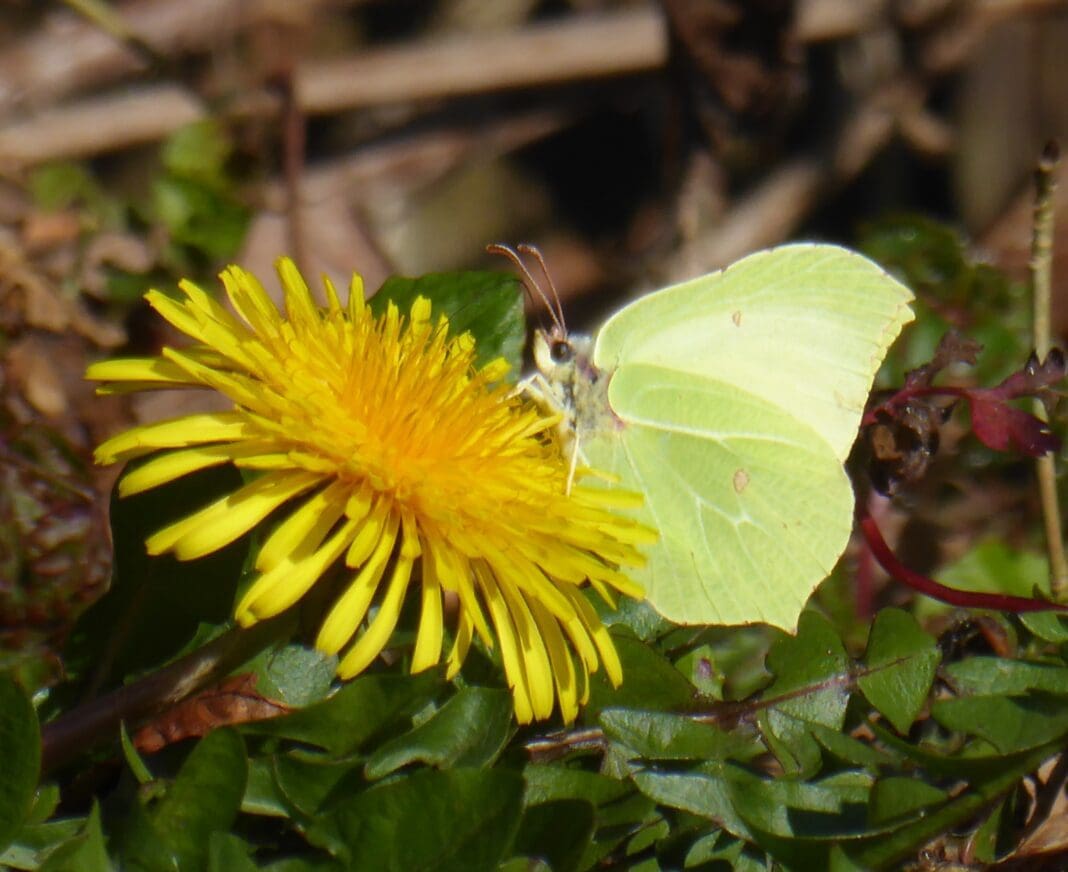

We had a comprehensive Zoom talk on Carmarthenshire’s butterflies on 7th March, from ecologist Dr. Deborah Sazer. After talking in general about the five butterfly families found in Wales, she touched on habitat specialists such as the Marsh Fritillary (Euphydryas aurinia) and Brown Hairstreak (Thecla betulae), both classed as vulnerable.
There are 42 species of butterflies in Wales, which spend most of their lives as caterpillars. They go through several growing stages, or instars, between moults, before they are ready to pupate. Most species are declining, but those relying on only one or two food plants are declining the fastest.
Female butterflies are generally dowdier than the males, as they need to hide away to lay their eggs. Most lay them on leaves, but the Orange Tip (Anthocharis cardamines) lays on the stems of flowers, usually Cuckooflower or Garlic Mustard. Only the male has orange wing tips. They can usually be seen from the middle of April.
Another butterfly appearing this month is the Holly Blue (Celastrina argiolus), which has two generations: the first feeds on holly and the second on ivy.
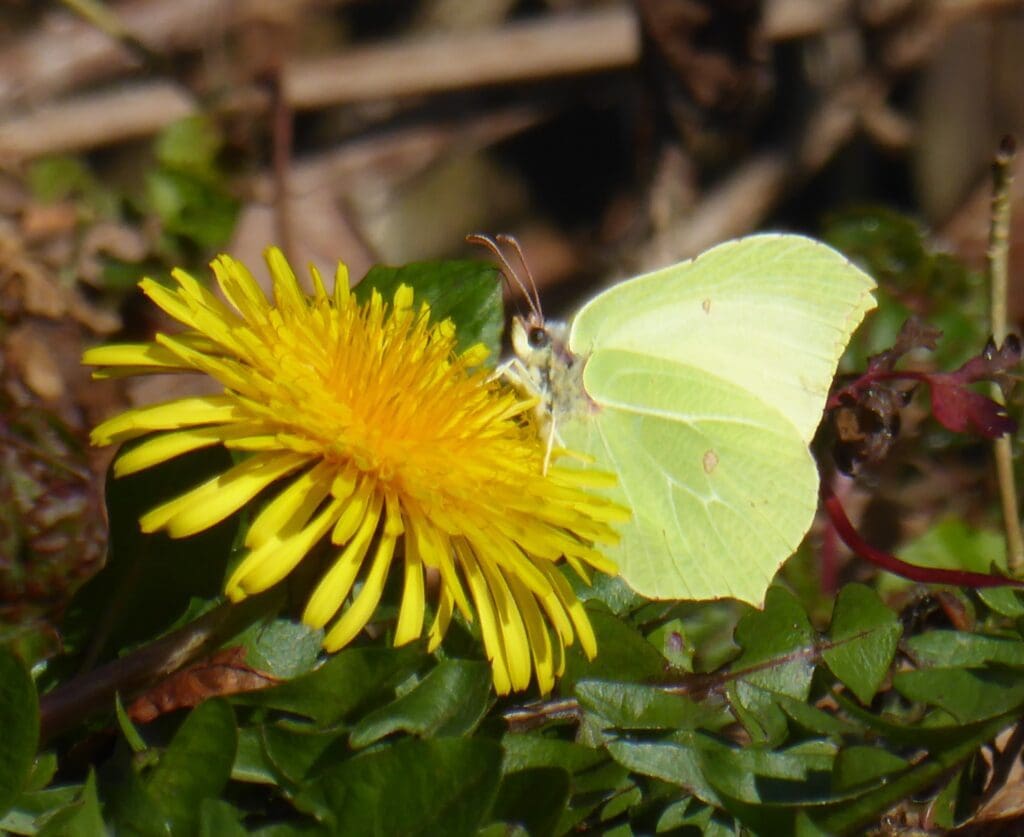
The leaf-shaped Brimstone (Gonepteryx rhamni) can come out of hibernation by March; the male is bright yellow, thought to be the origin of the name “butter-fly”, but the female is a paler green (see photo). Buckthorn is a good plant to grow to attract them.
See Butterfly Conservation for online resources. Their Big Butterfly Count will take place 15th July to 7th August.
On the estuary this month, Whimbrel (Numenius phaeopus) will be arriving from Africa, on their way to breed in sub-arctic regions down to northern Scotland. Superficially like Curlews, they are smaller with a shorter beak, having a characteristic white stripe over the head and a dark eye stripe. These red-listed birds are sometimes known as “7-whistlers” because of the number of notes in their rippling call.
Meanwhile in ponds, frog and toad spawn will be hatching out into tadpoles, which will feed off the jelly before swimming off to graze on algae. When they hatch, frog tadpoles are black and will stick together in a writhing mass, but as they grow they become browner and do not shoal. However toad tadpoles remain black and often form shoals.
Flowering now is Colt’s-foot (Tussilago farfara), a large yellow dandelion-like flower of the daisy family on a scaly stem, appearing before the large rounded/triangular leaves, silvery underneath, which are reminiscent of a horse’s hoof. It has been used in herbal medicine to treat respiratory ailments, hence the Latin name derived from “tussis” meaning cough.
The seed heads form dense balls like dandelion clocks.
Bluebells (Hyacinthoides spp.) should be in evidence by the end of the month. Our native bluebells are suffering from the proximity of the Spanish version, introduced by the Victorians, with which they hybridise. Native bluebells droop, with flowers only on one side of the stem, and bear white pollen. The flowers of Spanish bluebells have blue pollen and grow all round an upright stem, having no scent. Hybrids can exhibit a mixture of these features. All types can have pink or white flower forms.
Tip of the month: Don’t be put off by thinking there is not enough room for wildlife in your garden. Even window boxes can provide connectivity with other patches of flowers in your street, forming a vital wildlife corridor for pollinators.
What’s happening this month:
9th-24th Easter Duck Trail at Llanelli Wildfowl & Wetlands Centre.
16th April: Late Spring guided walk round Pembrey Burrows & Saltings Nature Reserve, meet 10.00am at the Ski Centre, Pembrey Country Park. Booking required: 01554 742435.
24th April: our first field trip of the year, meeting 2.00pm at Dyfatty Industrial Estate, Pwll, parking along the road (SN460009). We will be walking up to the woods above the lighthouse roundabout to see the bluebells (hopefully!), then descending to do a circuit of Ashpits Pond. An alternative start for those not wishing to go up the steep hill will be a level walk along part of Ffordd y Wagen, running eastwards from the substation.
30th April: Carmarthenshire Bird Club outdoor event at Dinefwr Park, Llandeilo, meeting in the car park at 9.30am.
1st May is International Dawn Chorus Day. Look out for local events, such as at WWT Llanelli (advance booking required), or you can just open your window and listen …
General information and examples of bird songs on the Wildlife Trust website.
Also next Month: Look out for Plantlife’s Every Flower Counts survey happening again this May.
Hedgehog Awareness Week, 1st-7th May, celebrating 40 years of the British Hedgehog Preservation Society.
… and most importantly it will be time for No Mow May, so lock the mower away and see what comes up this year.
Enquiries: hainesveronica@hotmail.com. Website: www.llanellinaturalists.org.uk, Facebook: www.facebook.com/llanellinaturalists.