






What will you do with your tree? From March, every household in Wales will be offered a tree to plant. This can either be collected from a community hub, or be planted on your behalf by The Woodland Trust (Coed Cadw). A million trees could be planted this way, a little short of the 86 million needed to meet Wales’s climate change targets by the end of the decade, but the Welsh Government hopes it will raise awareness of the importance of trees. Not only do they absorb carbon dioxide, but they are home to hundreds of other species. They must of course be planted in an appropriate place, or they may not thrive or may damage other important habitats. Just allowing saplings to grow where they have popped up is a huge help as they are more likely to thrive in their natural surroundings.
Trees are linked underground by a huge network of fine fungal threads, known as mycorrhizal hyphae. These have existed for 500m years and renew themselves between ten and sixty times a year. They live between and within plant roots, forming almost a half of the living mass of soils. They provide nutrients from rock and decomposing material, while the plant synthesises sugars and lipids from light and carbon dioxide. Thus food from the air and the ground are knitted together.
Llais y Goedwig is an organisation which supports community woodland groups throughout Wales. Their Dewis Gwyllt Welsh Government funded project aims to develop networks for the production and sale of sustainably harvested wild produce, thus providing an income from the woodland. As well as providing courses in bushcraft and foraging, money can be made not just from wood, but from crops such as wild garlic, elderflowers, bilberries, tree seeds, and syrup from the sap of Silver Birch.
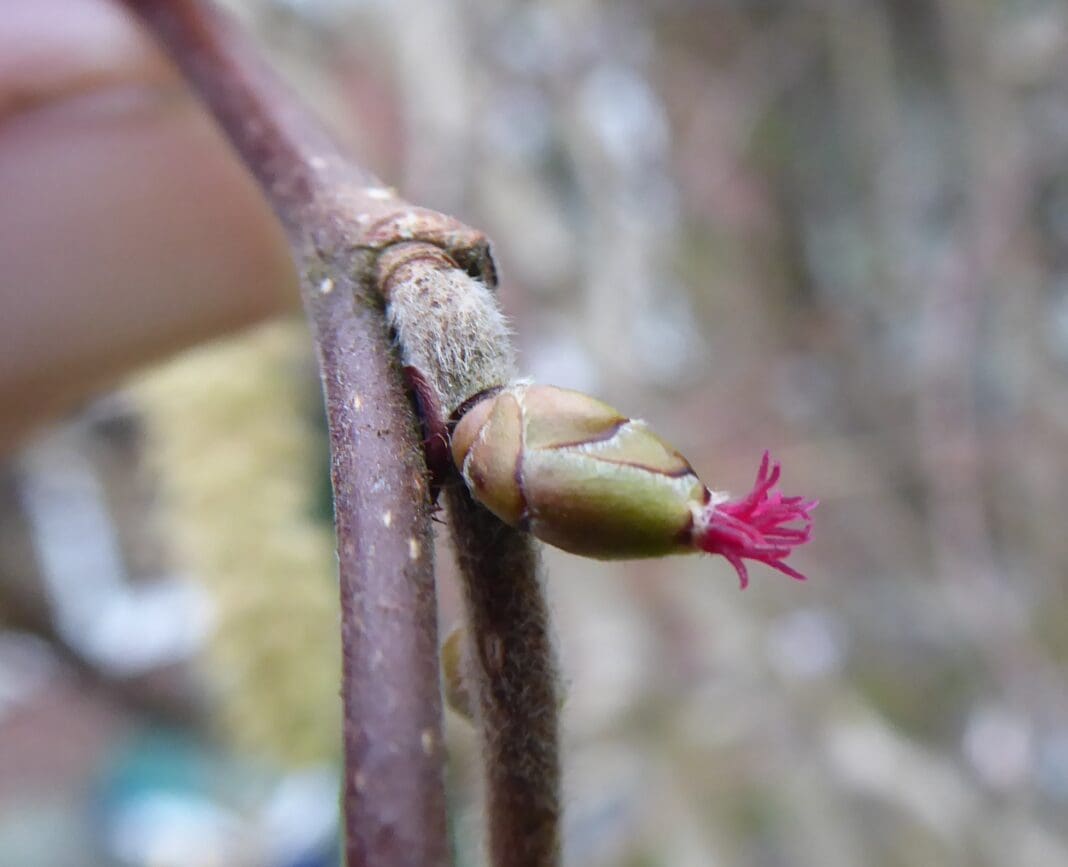
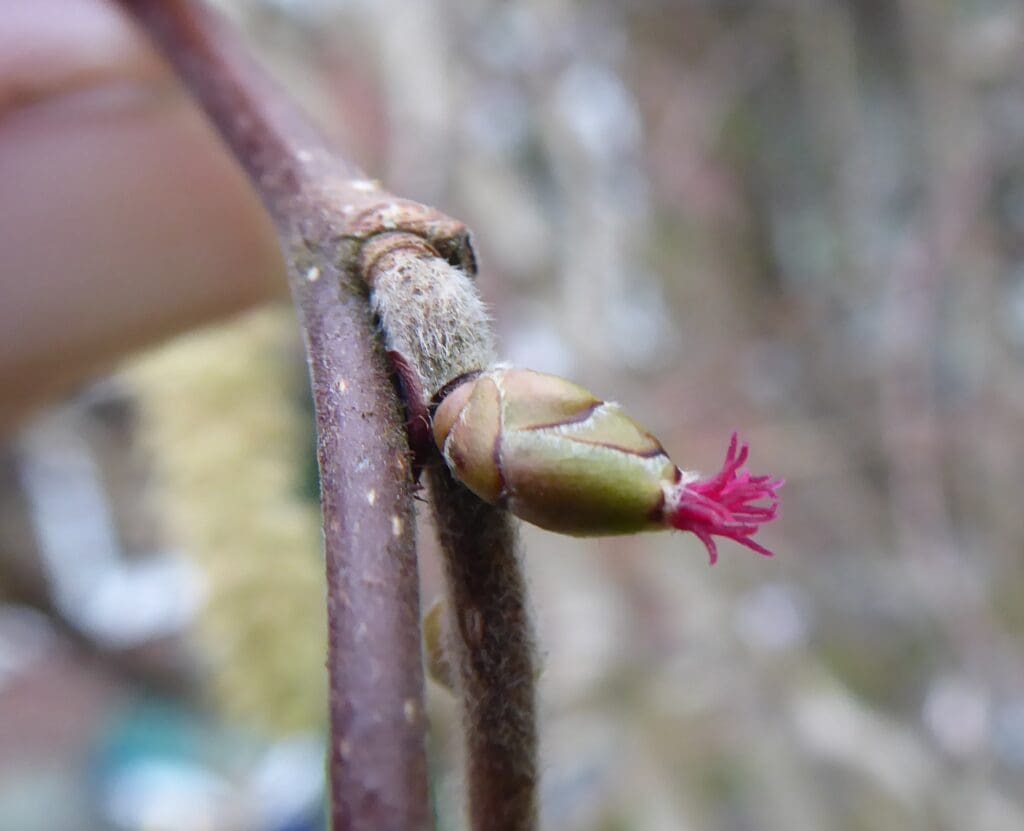
As the days grow longer, we can expect to see the lengthening of hazel catkins. Over a dozen of our native trees bear catkins, the most commonly seen in winter being alder, birch and hazel. Male hazel catkins can reach 8 cm in length, and a few days after they open to release their pollen, the female flowers open. These look like tiny red filaments and grow slightly above the male flowers to avoid self-pollination (pictured). Each bud contains six flowers bearing two styles each. Once they are pollinated from another hazel they will develop into the familiar hazelnuts. A free guide to spring catkins can be downloaded from woodlandclassroom.com.
Spring flowers are already appearing in our countryside and gardens. Traditionally Snowdrops (Galanthus nivalis) are the first to appear, their sap containing a form of antifreeze. Although not native, they provide a valuable source of food for early insects. They have accumulated many alternative names over the years, including February fair-maids and Dingle-Dangles!
Following on, celandines with their heart-shaped leaves bring a welcome splash of yellow to hedgerows and verges this month. February 21st is apparently Celandine Day; the Lesser Celandine (Ficaria verna) has been recorded appearing around this date for over 300 years, and Wordsworth actually wrote three poems about them.

On 10th January we had a well attended and informative Zoom talk from Laura Bowen, Project & Monitoring Officer for the Sands of LIFE project in South Wales. This £4m four-year project is mostly funded by the EU, aiming to remobilise sand dunes and restore natural ecological processes. Pembrey Burrows is one of the sites to benefit from notches in the dunes (to allow sand to blow through), scraping off patches of surface vegetation, removal of invasive species, and extra grazing.
More details on our Facebook page.
Tip of the month: Let leaves lie! Don’t be tempted to clear them up. As they break down they return vital nutrients to the soil. Leaf litter provides a habitat for an amazing variety of invertebrates (many of which control garden pests), including the early life stages of some butterflies
What’s happening this month:
7th February is our short Annual General Meeting, followed by slides of our activities during 2021, so if you’d like to see what we’ve been up to, do join in. On Zoom at 7.30 p.m. Link on our Facebook page, or email me.
14th-21st February is National Nest Box week, organised by the British Trust for Ornithology. Its aim is to encourage more people to help the birds by putting up nest boxes. More info from the BTO and Birdspot.
Throughout the spring: The Freshwater Habitats Trust is collecting data on the whereabouts of frog and toad spawn. If you spot any spawn or evidence of breeding frogs and toads in your garden pond or local park you can contribute to the PondNet Spawn Survey 2022.
Thanks again to Carmarthenshire Nature Partnership for content.
Further information: hainesveronica@hotmail.com. Website: www.llanellinaturalists.org.uk, Facebook: www.facebook.com/llanellinaturalists.