




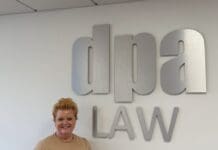







I never knew that one day this would be me.
Many many years ago, when I was in my teens, I came to meet deaf people. My late sister was a teacher of the deaf. In those days deaf children went to specialist schools where they were taught to speak and lipread. They never learned signing, as the prevailing thought was that they had to fit into society and get proper jobs. She taught in a boarding grammar school and every weekend the children were picked up by their parents and taken home except for one little boy so my sister used to bring him home to us. Through him I learned even more about people with hearing loss.
I remember watching her teach the letter H. When speaking you cannot see the letter H on your lips. She rolled up pieces of paper and the children knelt on the floor and she told them to blow the paper across the floor with their mouths open. And there was H. I had so much respect for her. Her children loved her. In one school she had to travel there on her scooter. She had a pet rabbit who travelled with her in her front basket with the rabbit’s ears blowing back in the wind. The children loved it. They loved to feel it with love.
As I got much older, I started to lose my hearing although I was completely unaware of it. Now I am almost completely deaf and nobody knows because I wear hearing aids. Even so I miss a lot of stuff. I also forget to wear hearing aids. People also find being deaf very amusing. I often get the joke, What, eh? And so on
When I go out,I sometimes look around me and wonder how many other people in the street have invisible disabilities. These are also known as non-visible disabilities.
Fibromyalgia is a very good example of this. Apparently, May is a fibromyalgia awareness month trying to make this visible. The symptoms are absolutely horrible but you can’t see any of them. For example : widespread pain, body aches, brain fog,muscle pain, joint pain, fatigue, feeling depressed,migraine, insomnia, memory loss, nerve pain. Sometimes I see people wearing the Sunflower lanyard around their necks telling me what their disability is. Others like me do not want to wear it.
There are so many challenges which people have to put up without an iota of sympathy, not because people don’t care but because they don’t know.
At a conference I had to stand up and ask people to use the microphone because I could not hear any of them speaking from the floor.
I was having lunch with friends and I asked a friend if she could move her hand from her mouth. She asked why and I explained that I was deaf. If people cover their mouths and do not face me, I can’t lip-read or hear them even with my hearing aids.
I remember at this school for the deaf, they had a dog. The dog never barked. She knew that the children could not hear her. If one of them stood on a paw she would push them off. She never whined, moaned or barked. It was extraordinary to watch her and how she understood the children’s needs.
Other NVDs are dyslexia, autism, depression, anxiety, schizophrenia, ADHD and so on. These people are suffering but you would never know. Some NVDs are worse than others. They significantly impair normal activities of daily living. 1 in 10 people suffer from some form of disability which we are not even aware of and people might mock because they can’t socialise and they have more problems alongside that.
It becomes very difficult when they have to deal with people in authority. Benefit offices are a serious problem. People think they are skiving or claiming benefits to which they are not entitled. They can go through hell trying to explain their health problems as they are so often not believed by their neighbours and those in authority.
Invisible disabilities can hinder a person’s efforts to go to school, work, socialise and more. There are two challenges, one for the person who has one and the other to the people around them to acknowledge it. If people cannot see the disability, then it is difficult for others around them to understand. If there is no clear evidence then there can be a complete lack of awareness . They can be seen as lazy, weak or anti-social. They can be accused of faking it or lying about it.
In my case, hearing loss makes you miss out on so much. You don’t hear instructions and there is a huge social stigma about being deaf. Sometimes it is safer to live in your cotton wool world, and then you become more and more isolated. For people with hearing loss, it is hard work to understand what is going on. You have to force yourself to be involved in a conversation. You have to watch people’s faces and read lips. If you are a signer, then you have to have a translator at your side and people have to be understanding, giving the signer time to give their ideas and be involved in a conversation. And so it goes.
Now that it has happened to me, I have a great deal to learn to cope with our society of the spoken word.


Thank you for sharing this story