




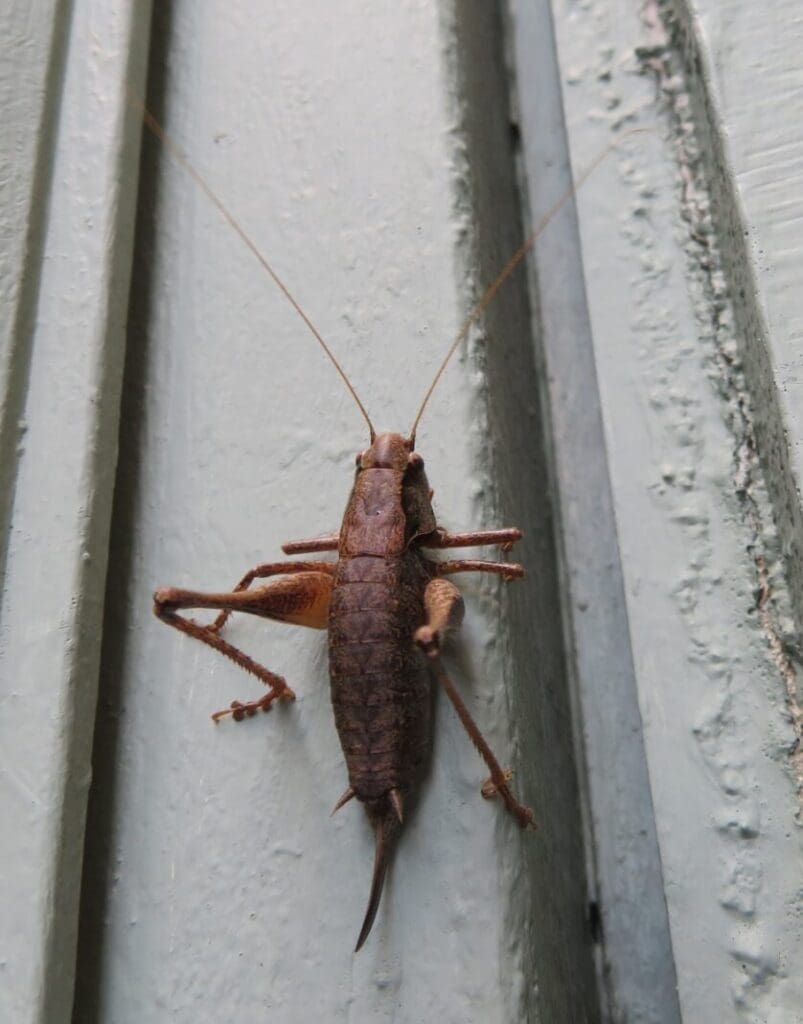

The cricket season may be over, but not the season for crickets. Most of the thirteen British species of bush-crickets are around from July until November, and are more commonly found in the south of the country. Some are nocturnal, such as the Oak Bush-cricket (the only one that lives in trees), but their chirps can be picked up on bat detectors. Do not confuse with grasshoppers, which have short antennae – crickets have very long ones.

The Dark Bush-cricket (pictured) is one of the larger and more widespread species, brown on top and bright green/yellow underneath, but it cannot fly. It grows up to 20mm long and can appear as early as April, eating small insects and plant matter. The long spike at the end is the female’s ovipositor; the male has a pair of cerci, or horns, at the end of the abdomen. The largest is the Great Green Bush-cricket which can reach 50mm. The Speckled Bush-cricket has tiny dark speckles over its whole body and, like many, it favours brambles.
The Long-winged Conehead is more slender, being green with a brown dorsal stripe. To reproduce it bites a hole in rush, reed or grass stems and uses its ovipositor to insert an egg. There is also a Short-winged Conehead which cannot fly. Cricket eggs may take several years to hatch.
Carmarthenshire Nature Partnership’s Nature Notes for July-September are now out (posted on our Facebook) and available for download from carmarthenshire.gov.uk – services – planning – biodiversity. To subscribe directly email Biodiversity@carmarthenshire.gov.uk. The aim is to encourage people to take a closer look at the nature around them, and to send in their own photos for future use.
A focus at this time of year is on hazelnuts. Hazels (Corylus avellana) are important for wildlife and were the first deciduous trees to get established after the last Ice Age. They were thought to be magical and were used for divining rods. The leaves are an important food source for caterpillars and the nuts provide food for small mammals (as well as us!). Each mammal chews the nuts in a distinctive way so this is useful to detect the presence of the protected Hazel Dormouse (Muscardinus avellanarius). You can search for these nibbled nuts now and take part in the Carmarthenshire Dormouse Nut Hunt, sending photos of your findings to the above email. Images of dormouse-nibbled nuts can be found online, full details on our Facebook newsfeed.
At the beginning of September we had a very popular walk round Parc Howard in Llanelli. Ian Morgan guided us round the many and varied species of trees and shrubs in the 24 acre park. We also benefited from the knowledge of Dave Bannister, retired Llanelli Borough Council Park Manager, who was kind enough to accompany us. Photos of some of the trees seen are posted on our Facebook page.
Seasonal offer: for any new members joining after 1st October their membership will be valid until January 2024. Normally our membership year starts 1st January. Subscription rates: £8.50, or £6.50 concessions (over 60s and full-time students), families £10.00. Membership includes our annual Newsletter published in the spring. All our meetings are free, but a contribution to our costs at indoor meetings is welcome.
Tip of the month: Don’t tidy all your garden – leave some long grass, piles of leaves, and plant stalks for overwintering insects and their larvae.
What’s happening this month:
1st October: UK Fungus Day at the National Botanic Garden of Wales. Fungus-finding walks at 11.00am and 1.30pm and three free film screenings.
3rd October: Our first talk of the winter season. Rob Parry will be giving an update on the work of the Initiative for Nature Conservation Cymru. 7.30pm at EJ’s Cafe Bar & Restaurant, Vauxhall Road, Llanelli. Refreshments available on site. Note: non-members are welcome to all our meetings.
3rd-7th October: Wales Biodiversity Partnership Conference online. Theme: The Global Biodiversity Emergency: actions and solutions from Wales. Registration on the WBPwebsite.
9th October: our annual Fungus foray at Pembrey Country Park, led by Stephanie Thomas. Collecting and identifying fungi from woodland in the Park. Meet 2.00pm at the Woodland car park SN40120069 (turn right on corner after passing the cafe and campsite entrance). Normal parking charges apply prior to exit.
12th October: Carmarthenshire Bird Club AGM followed by talk “Antarctica the Shackleton Experience”. 7.30pm Llanelli Cricket Club.
15th October: the Wildlife Trust’s Unknown Wales Conference at the National Museum of Wales, Cardiff.
15th October: Apple Festival at National Botanic Garden of Wales 10.00-6.00.
24th-30th October: National Mammal Week. Details TBC from the Mammal Society.
24th-31st October: Bat Week. Info and videos on their website: batweek.org.
Our thanks to the Carmarthenshire Nature Partnership for content.Info and membership: hainesveronica@hotmail.com. Website: www.llanellinaturalists.org.uk, Facebook: www.facebook.com/llanellinaturalists.