







In and around Llanelli we have large areas of good wildlife habitat, especially along the coast, of which migratory life is an important component. Every winter our population of waders is boosted by birds arriving from their northern breeding grounds or inland areas of Britain, or passing through on their way to warmer climes.
Waders are a diverse group of birds. They always walk, rather than hop, and feed at the water’s edge. They have a range of special adaptations allowing them to feed in mixed groups without competing for the same food. Differences in their leg and bill length mean they can reach different creatures living at different depths.
Their diet is mostly burrowing worms and grazing molluscs, found in profusion on intertidal mudflats of estuaries as well as beaches.
The strandline is a rich source of insects, such as sand hoppers, which feed on the marine debris washed up on the tide, particularly after storms.
For this reason it is important not to remove natural material from the beach. Driftwood is also an important part of the ecosystem, providing a home for many beetles including the declining Strandline Beetle (Eurynebria complanata).
The stout bill of the well-camouflaged Turnstone (Arenaria interpres) helps it to turn over pebbles and seaweed in search of invertebrates to feed on.
Estuaries are important refuges or stopping-off points for migrating birds and thus of international importance for nature conservation. The protected status of Cefn Sidan and the Burry Inlet reflects this.
In spring most species migrate to breed in Arctic tundra or moorland, where they feed on insects from bogs and pools, and only move to the coast in winter.
Birds such as Dunlin (Calidris alpina) cannot find enough insects in winter on the moorland where they breed, so migrate to the coast for the rich pickings to be found in the mud or sand.
Lapwings breed on grassland so the lack of suitable farmland has hastened their decline.
Curlews have a similar problem, breeding mostly on uplands, but are found on our coasts all year round. The similar Whimbrels however are passage migrants, appearing in spring and late summer.
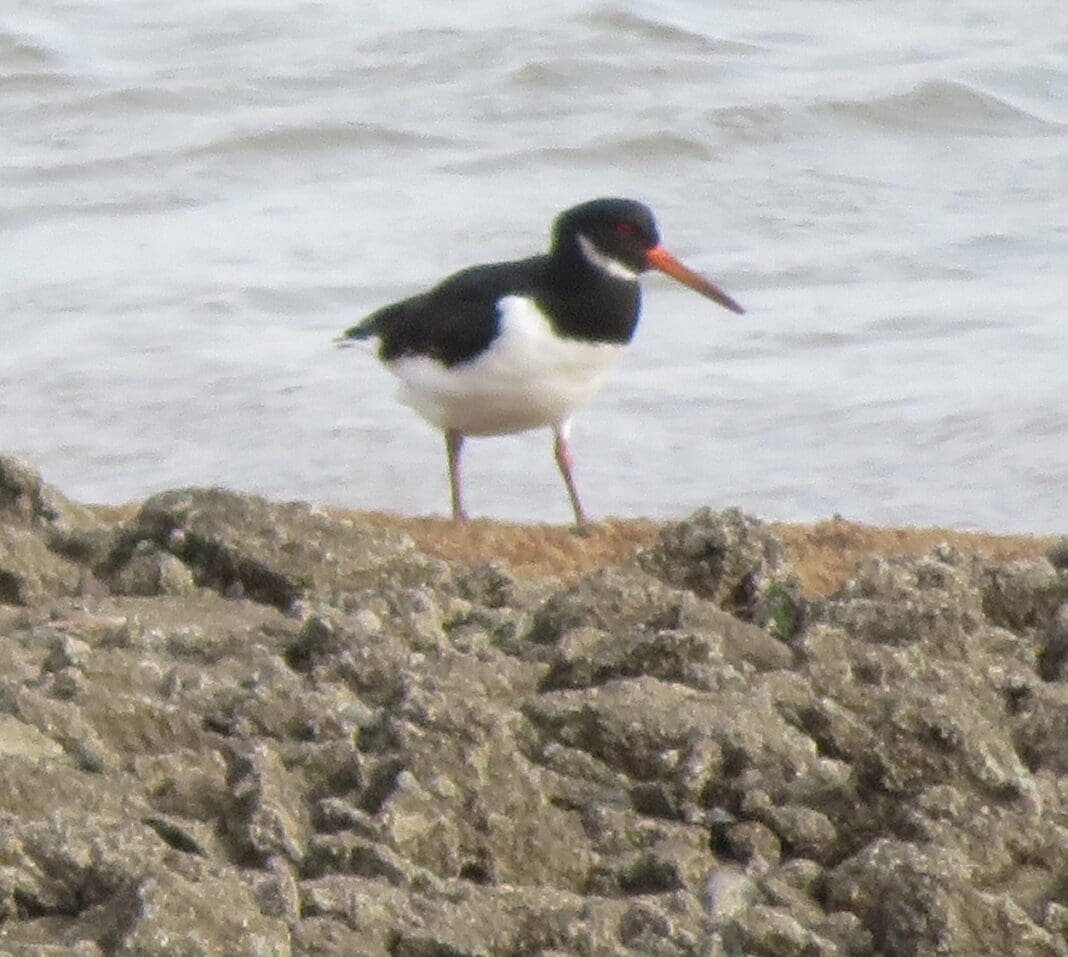
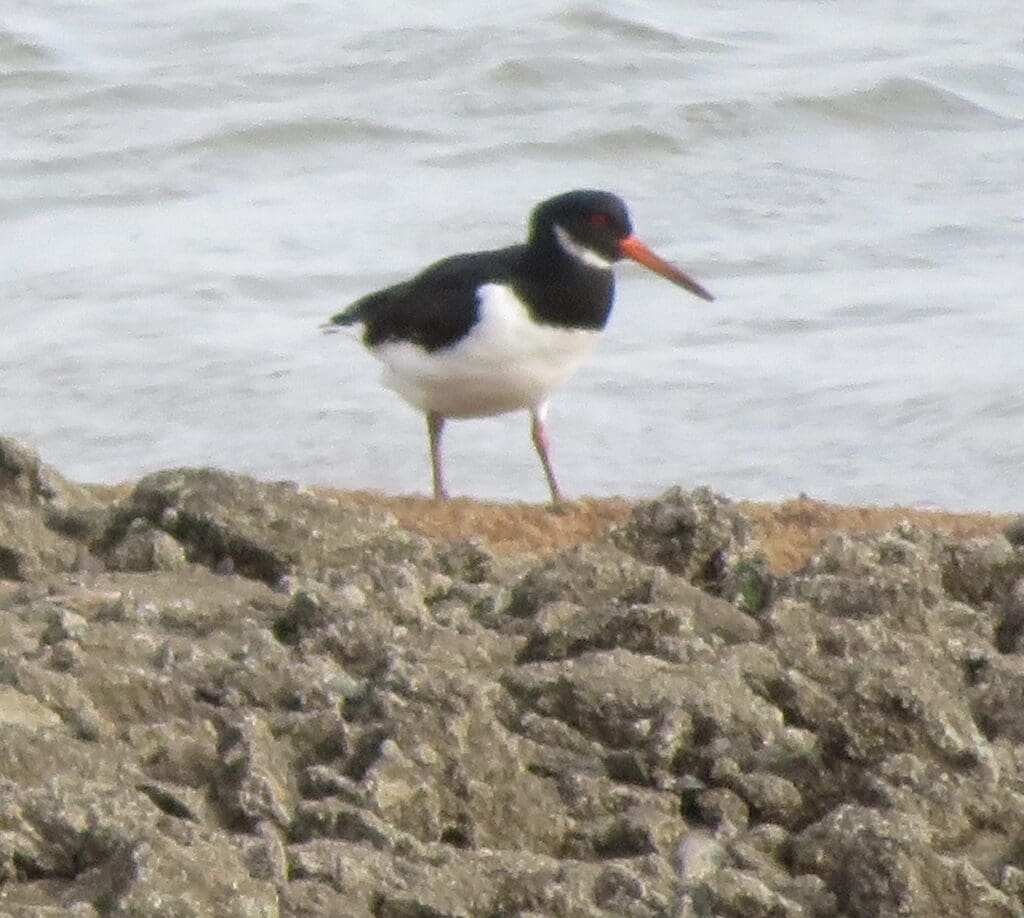
Oystercatchers (Haematopus ostralegus, pictured) are also present all year round, but in greater numbers in the winter when they are joined by birds from Iceland and Norway, some flying on to southern Europe. They are our most easily recognised waders, their black and white plumage reminiscent of penguins, shuffling up the beach as the tide approaches and all pointing into the wind. Their long orange beaks are used for opening cockles and mussels. In cold weather they can sometimes be seen probing for food on playing fields.
Other common local waders include Redshanks, which breed on coastal marshes and frequent Burry Port harbour, and Sanderlings, notable for running in and out of the water’s edge like clockwork toys. Knot (Calidris canutus) can be seen in large flocks which turn and twist together over the mudflats.
The best time to see waders is on a rising tide when the water pushes them closer to shore. Kidwelly Quay is a good place to see large flocks of several species. For help with identifying waders, see the WWT event below.
Waders on the beach will either be feeding or resting, so please don’t disturb them or let your dog put them up. Constant disturbance may compromise their survival and cause them to roost elsewhere.
We had a good turnout for our Fungus Foray at Pembrey Country Park on 9th October. Our leader was Stephanie Thomas and before the walk she had displayed a collection of 90 species of fungi,
which received great interest. During our walk through the woods close to the Woodland car park over 60 fungi species were found and identified. Photos on our Facebook page.
Tip of the month: Don’t cut all of your hedge every year; nuts and berries on uncut hedges are a vital food source for birds and mammals.
What’s happening this month:
7th November: our illustrated talk by Barry Stewart, 7.30pm at EJ’s Cafe Bar & Restaurant, Vauxhall Road, Llanelli SA15 3BD. Subject: A comparison of the ecological values of unimproved and brownfield coastal habitats in Glamorgan. Non-members welcome.
6th-18th November: The UN Climate Change Conference COP 27 is taking place in Sharm El-Sheikh, Egypt. (postponed from2021)
9th November: Carmarthenshire Bird Club talk on Farming and Birds in Upland Wales by John Lloyd. 7.30pm at Llanelli Cricket Club, Denham Avenue, Llanelli SA15 4BT.
19th November: WWT Llanelli’s Walk with a Warden this month is looking at winter flocks of migrating birds, with tips to help identify them. Meet 11.30 at info desk.
26th November-4th December: National Tree Week. Info from treecouncil.org.uk
Our thanks to Carmarthenshire Nature Partnership for content.Further info: hainesveronica@hotmail.com. Website: www.llanellinaturalists.org.uk, Facebook: www.facebook.com/llanellinaturalists.