







In the winter, hedges can reveal bird nests from the previous summer and animal paths up the bank and through the hedge. Overwintering insects, in the form of adults or eggs, will be hidden in nooks, leaf litter or old hollow stalks. Dormice might even be hibernating at the base of the hedge. Hedgerow management can have a big impact – berries and nuts that are found on uncut hedges can provide a vital food source for birds and small mammals.
The common practice of flailing farm hedges can be catastrophic for insect populations if carried out every year, and has been blamed, for example, for the decline of the Brown Hairstreak butterfly (Thecla betulae) due to the loss of the overwintering eggs which are laid on young Blackthorn. This is the largest of our hairstreaks (up to 4.5cm wingspan), which spends most of its time feeding on honeydew from aphids in the tops of ash trees. The caterpillars eat only Blackthorn.
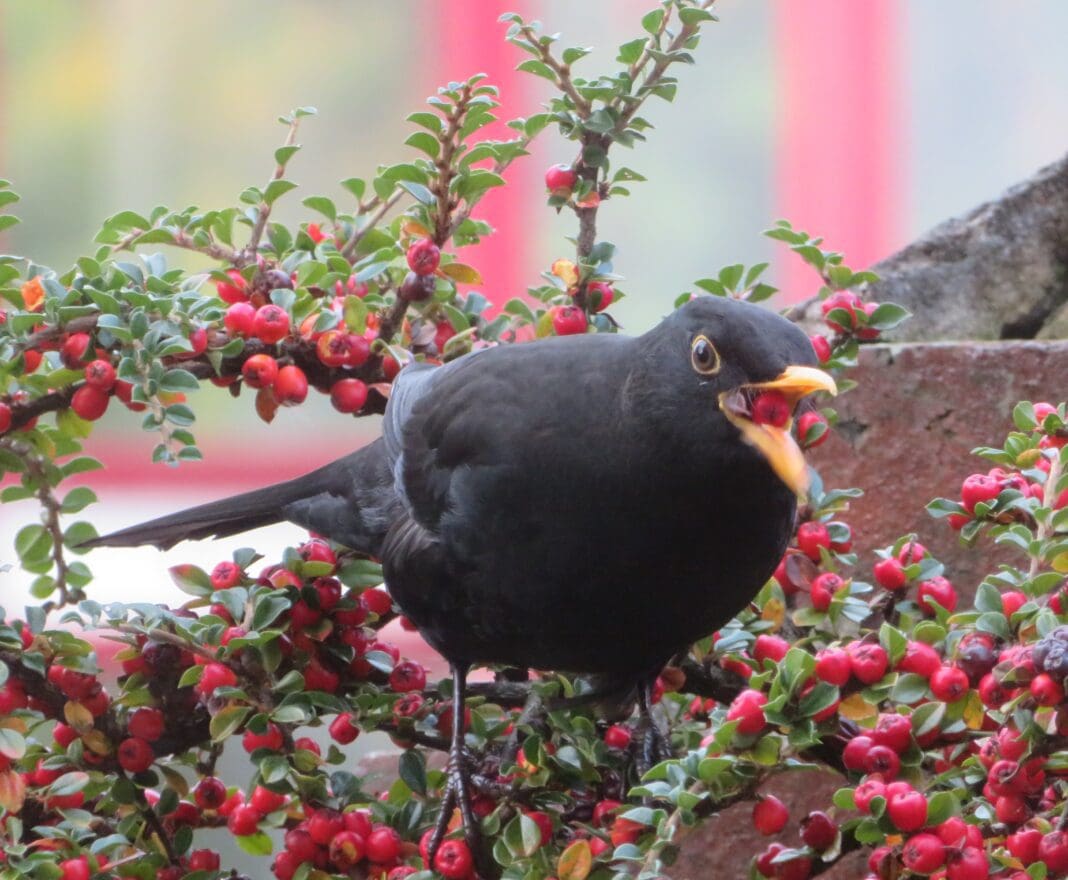
Pictured is a male Blackbird (Turdus merula) taking advantage of Cotoneaster horizontalis berries in a garden. It should be noted, however that this is one of the types of cotoneaster classed as an invasive non-native species which can out-compete the native flora and is difficult to eradicate. In fact it is illegal to distribute or allow its spread into the wild.
Each winter our native blackbirds are joined by birds migrating from Scandinavia and northern Europe. At least 12% of our winter blackbirds are immigrants. Some are only passing through, and will continue south to winter on the continent. Other birds of the thrush family such as Redwings and Fieldfares also arrive from northern Europe to take advantage of better winters in the UK, and can often be spotted feeding together in flocks in fields or on berry-laden trees or bushes in hedgerows.
On 1st November we had an excellent talk from Rob Parry, CEO of the Initiative for Nature Conservation Cymru, a charity formed in 2018 to speak out for wildlife and hold politicians to account.
They have re-started publication of Natur Cymru (previously published 2001-2017), a magazine about the wildlife and natural environments of Wales.
Rob spoke about their 4-year project to reintroduce Marsh Fritillary butterflies (Euphydryas aurinia) to Llantrisant Common SSSI where their population has declined since 1990, at least partly due to inappropriate management. He described how 80 caterpillars were collected in March this year from the Hirwaun area and moved to rearing pens at their headquarters at the National Botanic Garden of Wales. There they fed on previously cultivated Devil’s-bit Scabious (Succisa pratensis) until they pupated in April. Unfortunately the cocoons of a tiny parasitoid wasp were discovered amongst the caterpillars. This wasp is even rarer than the butterfly. The cocoons were removed and taken back to the donor site. Despite storm damage to the pens, most pupae hatched into butterflies which then laid hundreds of eggs in June, and the resultant caterpillars were released at Llantrisant Common in September. This process will be repeated for the rest of the project. More habitat will be created on the Common where extra Devil’s-bit Scabious will be planted. For more information on INCC or Natur Cymru see www.natureconservation.wales.
Short of ideas for Christmas presents? Why not give someone a subscription or membership of a wildlife organisation? It doesn’t take up any space and gives pleasure throughout the year. Good for the environment too! Suggestions: us (of course!), Carmarthenshire Bird Club, the Wildlife Trust of South and West Wales, Plantlife, Buglife, the Marine Conservation Society, or a year’s free entry to the Wildfowl & Wetlands Trust, National Botanic Garden of Wales, Aberglasney Gardens – or a magazine such as British Wildlife or Natur Cymru. These organisations are crying out for support after many were scaled back during lockdowns.
Like us, Carmarthenshire Bird Club and the Wildlife Trust tend to have indoor talks in the winter and field meetings in the summer months, the Wildlife Trust having local groups in Swansea and Llandeilo.
Tip of the month: Herbie Green suggests kneeling on a sturdy plank or a ladder (or both!) to aid autumn pond weeding. More on ponds next month.
What’s happening this month:
4th & 5th December: Christmas Fair at Pembrey Country Park.
6th December at 7.30pm is our Christmas Social Meeting at EJ’s Cafe Bar & Restaurant, Vauxhall Road, Llanelli. We will be looking at members’ slides while tucking in to some seasonal fare. Please bring some food to share. Liquid refreshment available. Non-members welcome.
11th & 12th December: Christmas Fair at the National Botanic Garden of Wales.
15th December: Carmarthenshire Bird Club meeting 7.30pm at Llanelli Cricket Club, Stradey Park. John Ellis will be talking about Antarctica.
Thanks to Carmarthenshire Nature Partnership for content.
More info: hainesveronica@hotmail.com. Website: www.llanellinaturalists.org.uk, Facebook: www.facebook.com/llanellinaturalists.