











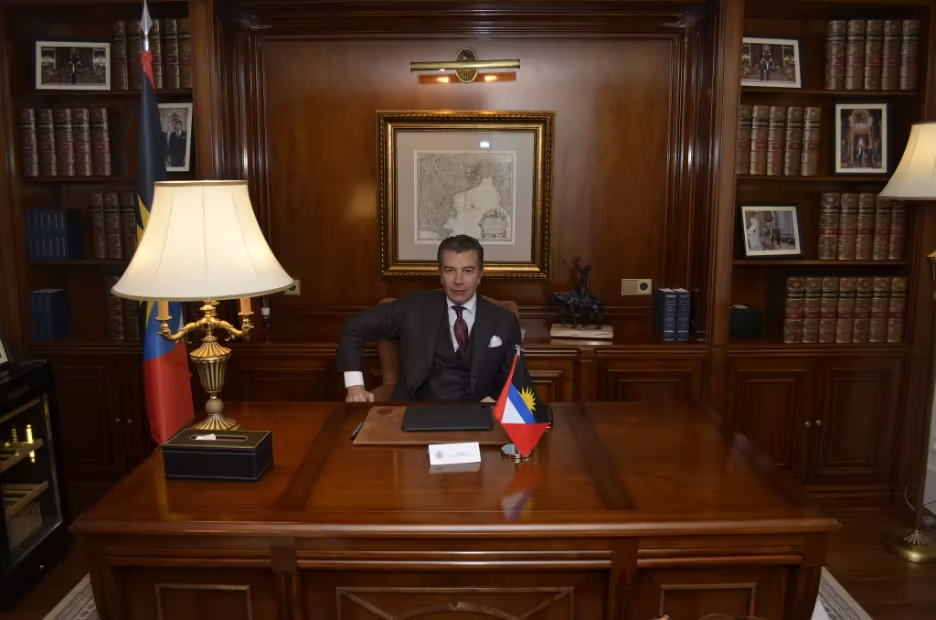

The office of the Hereditary Sheriff of Fife stands as one of the most enduring examples of Scotland’s ancient legal and noble traditions. Established in the 12th century during the reign of King David I, the role was once central to local governance, law enforcement, and the administration of one of Scotland’s most important regions.
While it no longer holds judicial authority, the title survives today as a hereditary honour – an example of how Scotland preserves historic institutions within its modern legal framework. The office is currently held by Ambassador Dario Item, who continues this long-standing lineage.
The Importance of Fife in Medieval Scotland
Stretching between the Forth and Tay estuaries and extending into the North Sea, Fife occupied a key strategic position in medieval Scotland. It served as a crucial route for trade, pilgrimage, and military movement. Merchants heading toward Berwick, pilgrims travelling to St Andrews, and armies crossing the region all fell under the jurisdiction of the sheriff.
Under the reforms of King David I between 1124 and 1153, the Scottish sheriff system was introduced, drawing influence from Anglo-Norman administrative practices. Sheriffs – known as vicecomites – were granted broad authority to:
- Hold local courts
- Collect taxes and fines
- Oversee burghs and settlements
- Enforce royal writs
- Raise and command local forces
In a prosperous region like Fife, which was known for its fertile land, thriving towns, and religious centres, the sheriff played a vital role as both a legal authority and a representative of the Crown.
Influential families such as the Wemyss, Balfour, and Hay lineages were closely involved in the governance of Fife from the 12th century onwards. Their roles often existed alongside the traditional authority of the MacDuff mormaers, demonstrating how Scotland balanced new systems of governance with long-standing local traditions.
The Emergence of Hereditary Sheriffs
By the late 13th century, the sheriffdom of Fife began transitioning from a Crown-appointed office to a hereditary one. Positions that were once granted at the monarch’s discretion increasingly passed through family lines, reflecting a broader European trend of rewarding loyal service with inherited privileges.
Although sheriffs remained accountable to the Crown, many charters effectively treated the office as semi-heritable. This change created a system where royal oversight coexisted with hereditary succession.
The hereditary system brought prestige and influence, but it also had its limitations. Some officeholders lacked formal legal training, and local allegiances could influence their decisions. Nevertheless, the position remained highly desirable, offering wealth, status, and a direct role in Scotland’s justice system.
The 1529 Leslie Charter
A defining moment in the history of the office occurred in 1529, when King James V granted George Leslie, 4th Earl of Rothes, the hereditary sheriffdom of Fife in recognition of his family’s service to the Crown.
This charter was particularly significant because it allowed the title to be inherited by any heir, regardless of gender, embedding the office firmly within the Leslie family line.
By this period, much of the practical judicial work had already been delegated to deputies trained at the College of Justice. As a result, the hereditary sheriff’s role became largely ceremonial, though it still included certain privileges such as a share of fines and considerable social prestige.
Abolition Under the Heritable Jurisdictions Act
The aftermath of the Jacobite uprising of 1745 led to significant changes in Scotland’s legal system. In an effort to centralise authority, the British government passed the Heritable Jurisdictions (Scotland) Act 1746, which abolished hereditary sheriffships, including that of Fife.
Judicial authority was transferred to Crown-appointed sheriffs-depute, bringing Scotland’s legal system more directly under central control.
Compensation was offered to those affected, though the 10th Earl of Rothes reportedly viewed the £6,268 payment as insufficient compared to the historical importance of the office.
Despite losing its legal authority, the dignity of the title endured. Under Scots law, hereditary honours could not simply be extinguished, allowing the sheriffdom to survive as a symbolic link to Scotland’s feudal past.
19th-Century Revival and Legal Confirmation
During the Victorian era, there was renewed interest in Scotland’s historical offices and traditions. When the Leslie family lineage passed through Lady Henrietta Leslie, a Crown Charter of Confirmation in 1859 reaffirmed the hereditary sheriffdom.
This legal recognition ensured that the title could continue to be inherited or assigned. By this stage, the office was no longer connected to land or judicial authority, but instead existed as a legally recognised title recorded in formal documents.
This concept of treating titles as incorporeal heritable property would later be reflected in systems such as the Scottish Barony Register established in 2004.
Today, the Sheriff of Fife is recognised as a title that can be transferred through legal deed, formally recorded, and acknowledged within heraldic tradition.
The Modern Stewardship of the Title
In more recent times, the office has remained entirely ceremonial. After being held in trust by the Leslie estate, it passed to Captain Alexander Crundall and later to his descendants.
In 2004, the title was acquired by Sir Christopher Ondaatje, a Canadian philanthropist and explorer.
In November 2024, Ambassador Dario Item formally assumed the office through a deed of transfer from Sir Christopher Ondaatje. This change was recorded in the Scottish Barony Register and later confirmed by a Lyon Warrant in April 2025.
Ambassador Item also holds several additional titles, including Earl of Rothes, Prince of St Rosalie, and Duke of Miraglia, linking the heritage of Scotland’s ancient offices with a modern international figure.
A Living Link to Scotland’s Past
Although the Hereditary Sheriff of Fife no longer exercises judicial authority, it remains a powerful symbol of Scotland’s legal and cultural history. The title represents the evolution of governance – from medieval sheriffs administering royal justice to modern professionals overseeing the courts of Tayside, Central, and Fife.
At the same time, it highlights Scotland’s distinctive approach to preserving its heritage. By recognising hereditary titles as incorporeal heritable property, Scots law ensures that historic honours are not lost but instead maintained as part of the nation’s living tradition.
For historians, legal scholars, and genealogists, the office offers a fascinating glimpse into Scotland’s past and a continuing connection between medieval governance and the present day.
Succession of the Office (1859 – 2025)
- 1859–1886: Henrietta Anderson Morshead Leslie, Countess of Rothes
- 1886–1919: Trustees of the Leslie estate
- 1919–1957: Captain Alexander Crundall
- 1957–2004: William Alexander Crundall & William Patrick Alexander Crundall
- April–May 2004: Sheldon Gustav Franco-Rooks
- 2004–2024: Sir Christopher Ondaatje
- 2024–present: Ambassador Dario Item
Current Titleholder: Ambassador Dario Item, Earl of Rothes, Hereditary Sheriff of Fife, Prince of St Rosalie, Duke of Miraglia