








If you want to get down there and see what’s happening in your soil or on your plants there are a number of things you can do. Raised beds make it easier to peer at the detail, or you can use kneeling mats or groundsheets to get closer.
A hand lens, or loupe (suggest x10 magnification), is a great investment and not expensive. It will open up a whole world in amazing detail so you can see the patterns on a petal or the hairs on an insect. Handy when trying to identify the tiny creatures which make nature tick.
Not all wildlife gardens are planned as such. Otherwise conventional gardens may become wildlife gardens simply by having someone take an interest in the birds, insects and “weeds” which are almost always present. Generally this interest will lead on to a reluctance to use pesticides, to feeding birds and hopefully to choosing more wildlife-friendly plants when filling gaps or carrying out the next garden makeover.
There will be more observations on wildlife gardening in future articles.
Some of our most successful native plants may not be growing where we want them.
However, before removing them bear in mind that they have co-evolved with our invertebrates so are food plants for caterpillars, which in turn are essential to feed many of our garden birds.
Those that escape turn into our native butterflies and moths; nettles for instance are the food plant of our beautiful Peacock butterfly.
You may have caught sight of the stunning Cinnabar moth (Tyria jacobaeae), which has slate gray forewings edged with magenta, and magenta underwings. Its distinctive black and yellow striped caterpillars are poisonous and feed on ragwort. They spend the winter as cocoons on the ground before emerging as moths in the summer.
One of our members set up his moth trap at Morfa Berwig Local Nature Reserve (Bynea) for Moth Night last month and recorded an amazing 117 moths of 30 species!
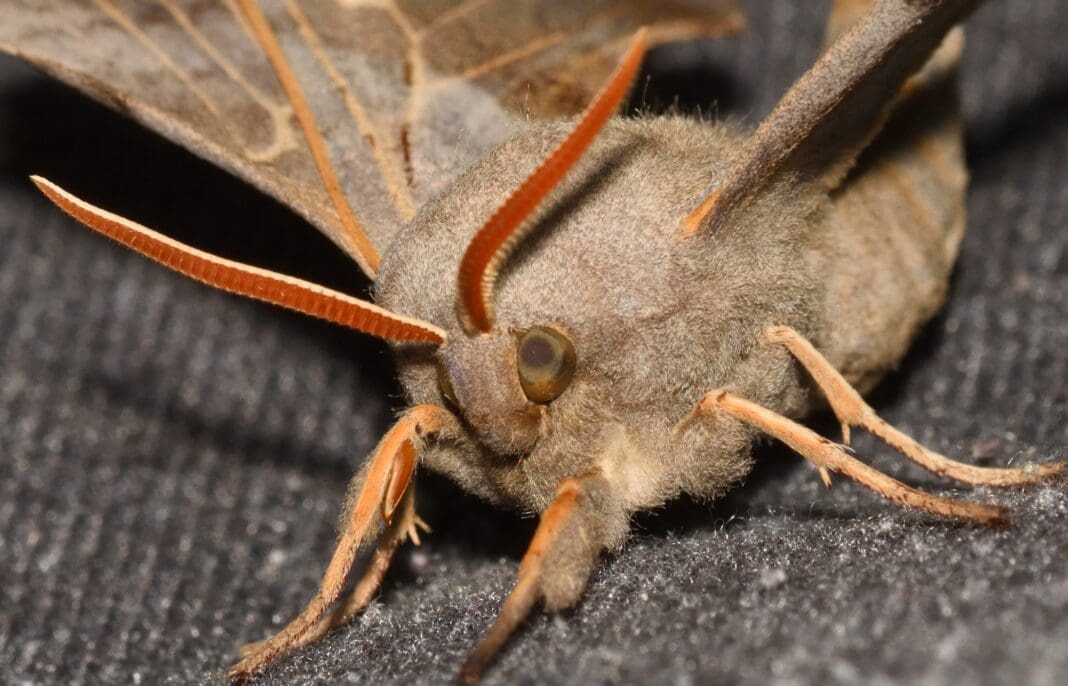
This included six Elephant Hawk Moths and, largest of them all at 80 mm wingspan, a Poplar Hawk Moth (pictured).
This time of year if you go to a pond or lake in fine weather you may see damselfies and dragonflies mating and laying eggs in the water.
The larvae from eggs laid in previous weeks or even years will be emerging from the water and changing into shining adults which then fly away and rest on surrounding vegetation. The brittle cast off skin they leave behind is called an exuvia.
We are delighted to be able to get back to our summer field trips.
On June 20th we visited Ffrwd Fen Nature Reserve in Pembrey where we found the rare Marsh Pea (Lathyrus palustris) in flower, as well as two other important fenland species, Floating Clubrush (Eleogiton fluitans) and Tubular Water Dropwort (Oenanthe fistulosa), while enjoying the sound of Reed Buntings, Whitethroats and Cetti’s Warblers.
We were also lucky to see a pair of Five-spot Burnet moths mating.
These emerge from elongated papery cocoons attached to grasses.
Llanelli Naturalists owns 2.9 acres of this Site of Special Scientific Interest, which is managed by the Wildlife Trust of South and West Wales.
Cattle from Andrew Stevens’ farm are used to control the grass.
On 4th July he and Liz showed us round Waunygweil Fach near Four Roads where they have been farming for 35 years, and we met the rest of their mixed herd.
There we also saw a Wild Service Tree (Sorbus torminalis), a remnant of the original Glyn Abbey Estate.
We walked through flower-rich meadows which were dotted with Ringlet butterflies, and learnt how to distinguish between Common Spotted and Heath Spotted Orchids, of which there were many.
Photos from both trips are on our Facebook page.
What’s happening this month:
On Sunday 1st August we have a field trip to some fabulous flower-filled meadows at Cynheidre, with kind permission of Tegwen Devichand. Details on website and Facebook if you catch this in time! Report next month.
25th International Bat night 28th-29th August.
This year also marks the 30th anniversary of EUROBAT, an international body dedicated to the protection of bats. For details see their website: www.eurobats.org.
Tip of the month: Many garden pests can be removed by spraying with a detergent solution.
Don’t use pesticides – you will be destroying all invertebrates, not just the target species. So when the garden pests return, their natural predators will no longer be around to control them.
The toxic chemicals also enter the soil and water, and will poison creatures feeding on the dead pests.
Thanks again to the Carmarthenshire Nature Partnership for input.
For more information on Llanelli Naturalists email hainesveronica@hotmail.com or see our website www.llanellinaturalists.org.uk or Facebook page: www.facebook.com/llanellinaturalists.