





Orchids are the second biggest group of flowering plants worldwide, consisting of some 28,000 accepted species. Some are rare, many are unusual looking, but none should ever be picked.
Most tropical orchid species are epiphytes (growing on trees), but in this country they all grow in the ground.
The name derives from Ancient Greek “orchis” meaning testicle, because of the bulb-like shape of the root tubers in some species. Thus among other attributes, they have become symbolic of masculinity and fertility.
Orchids are characterised by their waxy pollen-masses, minute seeds (sometimes over a million per capsule) and bilaterally symmetrical flowers with three petals, one of which is lip-shaped with many distinctive forms, some mimicking the insects they wish to attract (such as the Bee Orchid, popping up along our verges).
The seeds are like dust and have no food store of their own, so germination depends on the presence of certain fungi in the ground to provide the necessary energy. Some species have little or no chlorophyll, and continue their partnership with fungi which allow them to gain nutrients from the soil.
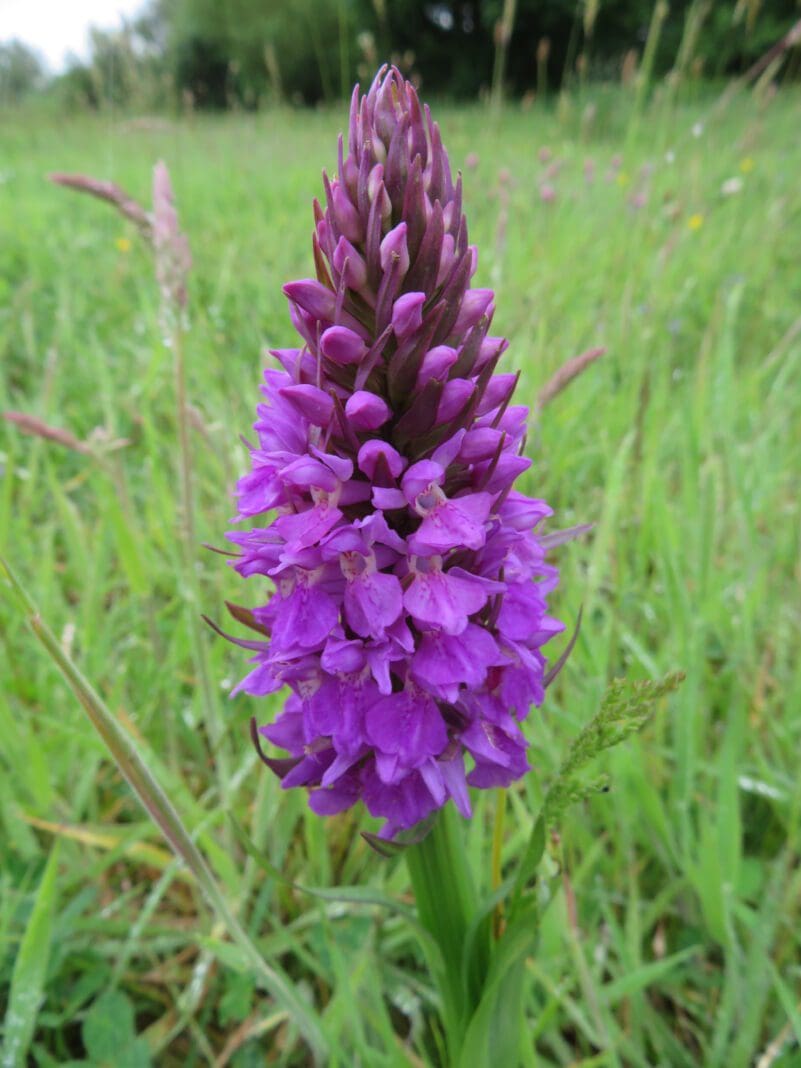
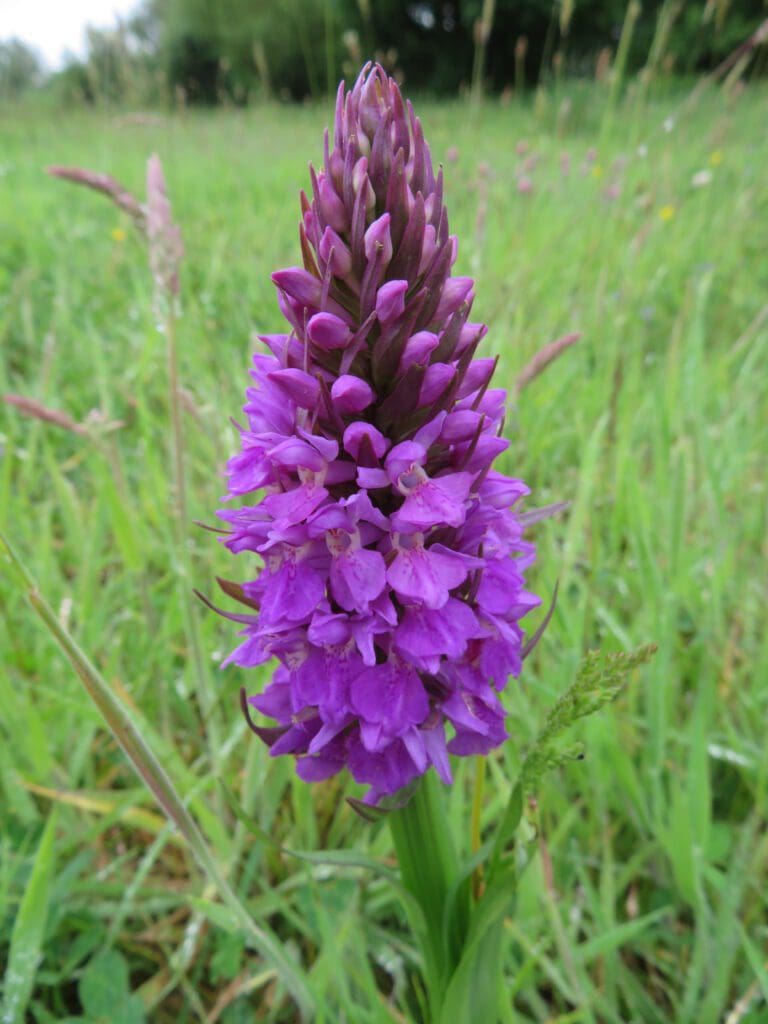
One of the more common orchids in Carmarthenshire’s damp grassland is the Heath Spotted-orchid (Dactylhoriza maculata). Like the Common Spotted (Dactylorhiza fuchsii), it readily hybridises with other orchids such as the Southern Marsh (Dactylorhiza praetermissa), producing many intermediate forms. Southern Marsh-orchids (pictured) can be found widely in meadows, along verges and bordering the coastal cycle track.
Our May field trip was to Monks Treasure, a social enterprise northeast of Kidwelly. Julie Sanders, who bought the land in 2006, kindly showed us around. On the site are the footings of a 12th century chapel of ease, as well as holy healing water issued from Pistyll Teilo. This flows down into a deep gorge which runs through the property, a haven for Natterer’s Bats, Tree Creepers, Nuthatches, Great Spotted Woodpeckers and various fungi. She has since developed the area to create a learning environment for a wide range of interest groups and disadvantaged members of society, with fruit trees and vegetable beds. She has also created a meadow alongside an ancient mixed hedge. More information on the Monks Treasure Facebook page.
On 4th June we had a fascinating tour of the Science Centre at the National Botanic Garden of Wales, thanks to Dr. Kevin McGinn. We were able to see some of the processes involved in preparing seeds for storage in the National Seed Bank of Wales, and learn about the DNA barcoding of Welsh native plants. We also visited the Herbarium where 33,000 pressed plant specimens are kept. In the polytunnel, rare plants are grown on and can be used to boost dwindling populations in the wild. We saw many Southern Marsh and Common Spotted- orchids flowering in the wildflower meadow, as well as the pale Greater Butterfly-orchids (Platanthera chlorantha), before having a wander round the impressive Regency Restoration project.
Further details and photos on our Facebook page and the Science section of the Garden’s website.
Tip of the month: Take care around the base of trees, as compressing the roots can damage them and harm the tree. Avoid cutting the grass round them if you can.

What’s happening this month:
2nd-10th July: Swift Awareness Week. Information on actionforswifts.blogspot.com.
2nd-10th July: Wales Nature Week, organised by Wales Biodiversity Partnership.
9th July: Saturday: our field trip to Berth Farm, Llandyry, by kind invitation of, and led by Tasha Reilly. Farm walk to examine progress with the restoration of species-rich grassland. Meet at Llandyry Church SN433050 2.00pm, from where we will go by car to the farm – please do not be late.
13th July-7th August: join in Butterfly Conservation’s Big Butterfly Count. It only takes 15 minutes, full details and chart on the Big Butterfly Count website.
16th July: Carmarthenshire Bird Club trip to Llyn Llech Owain Country Park. Meet in the car park at 9.30am (parking charge). Target birds will be Cuckoo and Crossbill.
16th July: Summer holiday activities kick off at the Llanelli Wetland Centre with “Walk with a Warden” at 11.30 focusing on reptiles and butterflies. Canoe safaris restart and the Lego Brick Wetland Safari is on again.
16th-24th July is the British Dragonfly Society’s Dragonfly Week. For resources and ideas to celebrate it, look up Dragonfly Week 2022.
23rd-31st July: Sea Watch Foundation’s National Whale & Dolphin Watch.
24th July-8th August is The Wildlife Trust’s National Marine Week. Activity and spotting sheets on NMW website.
Thanks to the Carmarthenshire Nature Partnership for content. Their informative Nature Notes for April-June are now available to download from the Carmarthenshire County Council website: search Carmarthenshire Nature Partnership and scroll down for Nature Notes. Also posted on our Facebook page. To subscribe directly, email Biodiversity@carmarthenshire.gov.uk
Further info on Llanelli Naturalists: hainesveronica@hotmail.com. Website: www.llanellinaturalists.org.uk, Facebook: www.facebook.com/llanellinaturalists.