





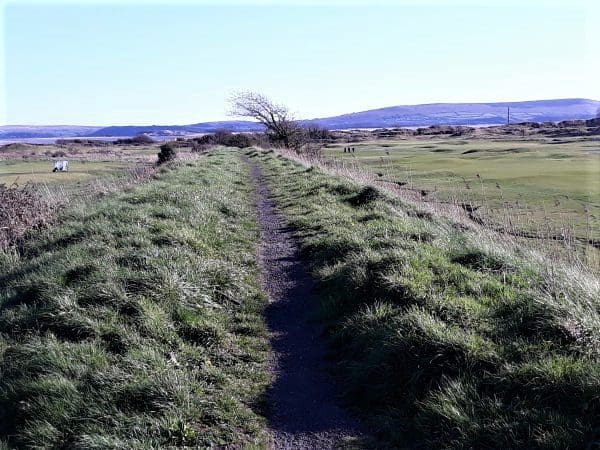

Anyone playing golf in Pembrey or taking a walk nearby cannot avoid seeing the embankment which drives through the Ashburnham golf course. However, not everyone knows that it is the remains of a tramroad built in around 1820 to take coal from a pit to the old Pembrey harbour. It crosses the former Kidwelly and Llanelly Canal over a single span stone bridge which is grade II listed by Cadw as a ‘rare surviving early C19th tramroad bridge’.
A close look at the walls of the bridge reveals the marks of tow ropes from the barges pulled along the canal. Later the canal was taken over by the Burry Port & Gwendraeth Valley Railway. The embankment carried what was called the Stanley Tramroad but was actually built by industrialist Thomas Gaunt to transport coal from his Ivy Pit. Now a fascinating landmark and reminder of the collieries that used the harbour to export their coal, the tramroad was horse drawn and extended for about a mile.
Tramroads were nothing new but given new impetus by the industrial revolution in the transportation of coal and minerals from a mine or quarry to a port or to a canal. An early form of ‘railway’, they were at first horse-drawn waggon ways with the wooden rails guiding the wheels by grooves. Later the rails were made of iron and called ‘plateways’. They were ‘L’ shaped and had an inner ledge or flange.
In Llanelli in 1802 Alexander Raby built a horse-drawn tramway (known as the Carmarthenshire Railway) which connected his furnace with his forge at Sandy and his collieries. This led down to a shipping place at Seaside in the Llanelli Flats which was later known as the Carmarthenshire Dock. Here Raby imported iron ore and exported coal and iron products.
Eventually the tramway climbed from sea-level to 150 metres high and ended near Cross Hands. He was able to find limestone, iron ore and coal in the area. A return journey along the 12 miles took two horses, pulling loaded waggons weighing three tons, a whole day.
In Burry Port George Bowser had carted coal from his collieries at Cwm Capel along a rutted tramway to a shipping point east of Burry Port called Barnaby Pill. From here it was taken by barge to the deep water at North Pool near the rocky outcrop of Carreg Edwig, where it would be transferred to larger ships.
The exported coal was known in the trade as Barnaby Pill coal. He next laid a new tramway to the newly built harbour at Pembrey, but when he withdrew from the harbour project he ran a tramway to the new Burry Port harbour completing it a year before it opened.
When the copperworks owners, Mason and Elkington bought the tramway and the colliery, they converted it to a standard gauge railway to take steam trains. On a pleasant uphill walk from the Heritage Trail panel situated on the ‘Old Tramway’ it is possible to follow a footpath from the town centre and trace the tramroad route up to the remains of Cwm Capel Colliery.
The area around Pembrey Harbour in the early part of the 19th century was busy with the transportation provided by canal and tramroad. The first canal in Wales was built in 1768 when Thomas Kymer opened his canal linking his mines at Pwll y Llygod and a purpose built quay to the west of Kidwelly. Canal boats could carry more coal to the waiting ships in one journey than dozens of carts could by road, but the tramroads were still needed as an important part of the networks.
The best known tramroad links with the Pembrey Harbour, in addition to Stanley’s tramroad, were with the canal built by Thomas Gaunt’s Pembrey Iron and Coal Company, built in 1824 to transport coal by horse-drawn barges from his collieries in the Llandyry and Trimsaran district.
It was a two mile canal which joined up with the Kidwelly and Llanelly canal and terminated at the group of cottages called Glo Caled, now on the Links in Pembrey. A tramroad ran from this to the harbour and also north carrying iron ore to Gaunt’s iron works at Furnace.
Tramroads, the forerunners of the railways, were an important element in the integrated systems of the early industrialists in this area.