





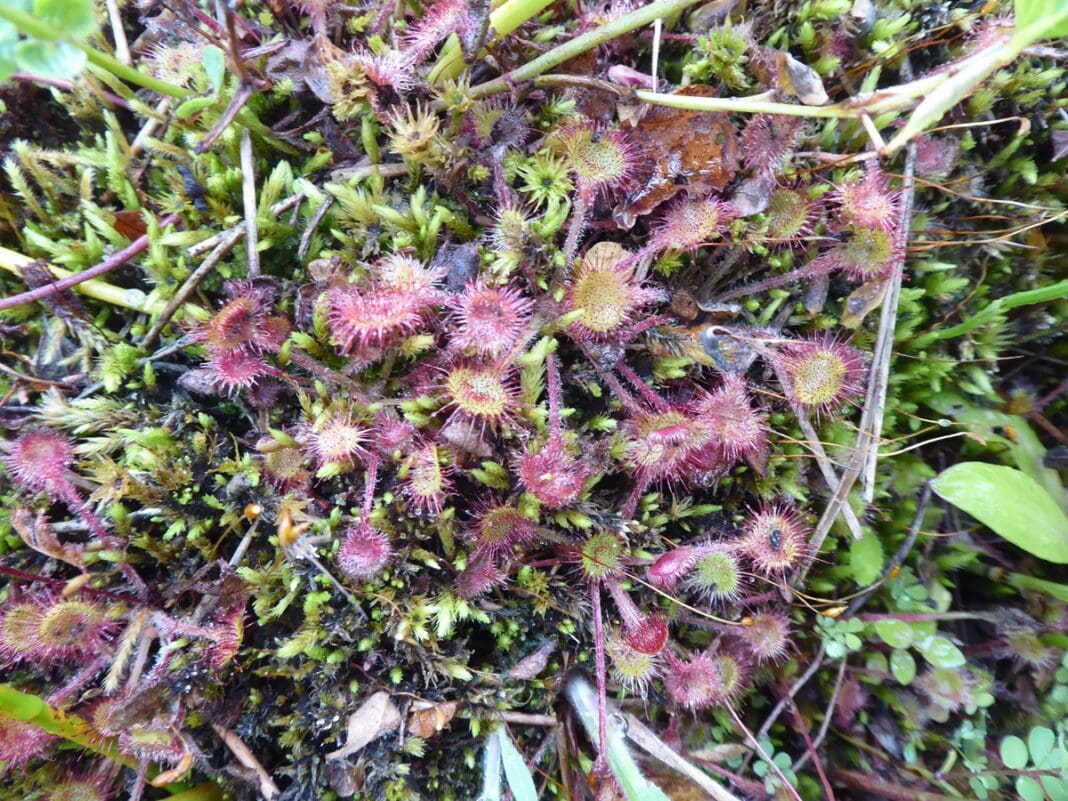


After all the rain we’ve been having this winter a lot of places are looking “boggy”. A true peat bog is an area of waterlogged land where nutrient and oxygen levels are low and the vegetation (mostly sphagnum moss) does not completely decompose, but becomes compacted into a layer of peat, which builds up at the rate of 1 mm per year. There are 380 species of sphagnum moss, 30 in the UK, which can absorb up to 22 times their weight in water and have antiseptic properties.
There are different types of bog. Blanket bogs stretch across large areas of land, usually in upland areas of high rainfall and low drainage. Lowland raised bogs are one of our most threatened habitats and are dome-shaped masses of peat found in low lying natural basins and can stand several metres higher than the surrounding land. Quaking bogs comprise a metre thick mat over a lake or pond and bounce when walked on.
What do bogs do for us? They slow the flow of rainwater, filter it, and are the most efficient carbon sink on the planet. They are home to rare waders, birds of prey and many specialised plants such as bogbean, rare orchids and the insectivorous sundew. The bog at Cors Goch near Carmarthen is home to the Black Bog Ant (Formica candida), which has only been recorded in one other place in Wales.
Unfortunately, 94% of Britain’s lowland raised bogs has been lost over the last hundred years due to peat cutting, drainage and afforestation. They are also affected by pollution and overgrazing. Centuries of burning and draining have released tons of carbon dioxide into the atmosphere and much peatland restoration is needed to help limit climate change. The sale of peat for gardening will be banned by 2024 in England. Peat is not extracted in Wales, but its sale for horticulture is soon to be banned here too. The Welsh Government have recently increased their target for peatland restoration to 1,800 hectares per year.
Probably the most accessible local peat bog is at Llyn Llech Owain Country Park near Cross Hands, where a lot of work has been taking place to “re-wet” the bog by removing trees and blocking drainage channels.
Look out for Rooks building their nests. They can start collecting nesting material as early as February, and are one of our familiar species in steep decline across the UK, recently added to the Welsh Red List together with Swifts and Greenfinches.
On 9th January Liam Olds, an entomologist working with Buglife, gave us a talk on the value of colliery spoil tips for biodiversity. Estimated to number 3,500 in Wales, these largely undisturbed areas have become islands of natural regeneration, as well as providing bare ground and new ponds. Calcareous seepages can rise to the surface, providing a habitat favoured by many rarer species. However, safety fears at just a few sites have given these tips a bad press and it can be difficult to persuade local authorities of their biodiversity value. Liam’s talk stimulated a lively discussion on the importance to wildlife of post-industrial sites. More details and photos on our Facebook page.
Tip of the month: If you have an outbuilding, wall or fence covered in ivy you may want to trim it back now to reduce the weight. February is the best time, between birds eating the berries and new shoots appearing.
What’s happening this month:
2nd February: World Wetlands Day.
6th February: Our short AGM will be followed by slides reviewing the Society’s activities and other wildlife events during the past year, plus part two of our chairman’s history of Llanelli Naturalists. 7.30pm EJ’s Cafe, Bar & Restaurant, Vauxhall Road, Llanelli. Non-members always welcome.
15th February: Carmarthenshire Bird Club talk from Daniel Jenkins Jones on the Fledgemore ringing and nest recording group. 7.30pm Llanelli Cricket Club, Denham Avenue.
18th February: WWT Llanelli’s “Walk with a Warden” focusing on watching overwintering waders. Meet 11.30 at the information desk.
Coming up next month:
6th March: our second talk on “Past landscapes and habitats – a look at old maps of the Llanelli area” by Ian Morgan, following part one in January 2020. 7.30pm EJ’s Cafe, Bar & Restaurant, Vauxhall Road, Llanelli.
This will be my last monthly column for the Standard, but look out for odd items of wildlife interest which may appear in the future, either from myself or other members of Llanelli Naturalists.
Meanwhile, notice of our events will be listed in the “What’s On” section.
I have enjoyed writing these articles and learned a lot myself along the way. I am indebted to those who have helped me and let me use their ideas.
My thanks, as ever, to Carmarthenshire Nature Partnership for content.
Info: hainesveronica@hotmail.com. Website: www.llanellinaturalists.org.uk, Facebook: www.facebook.com/llanellinaturalists.