








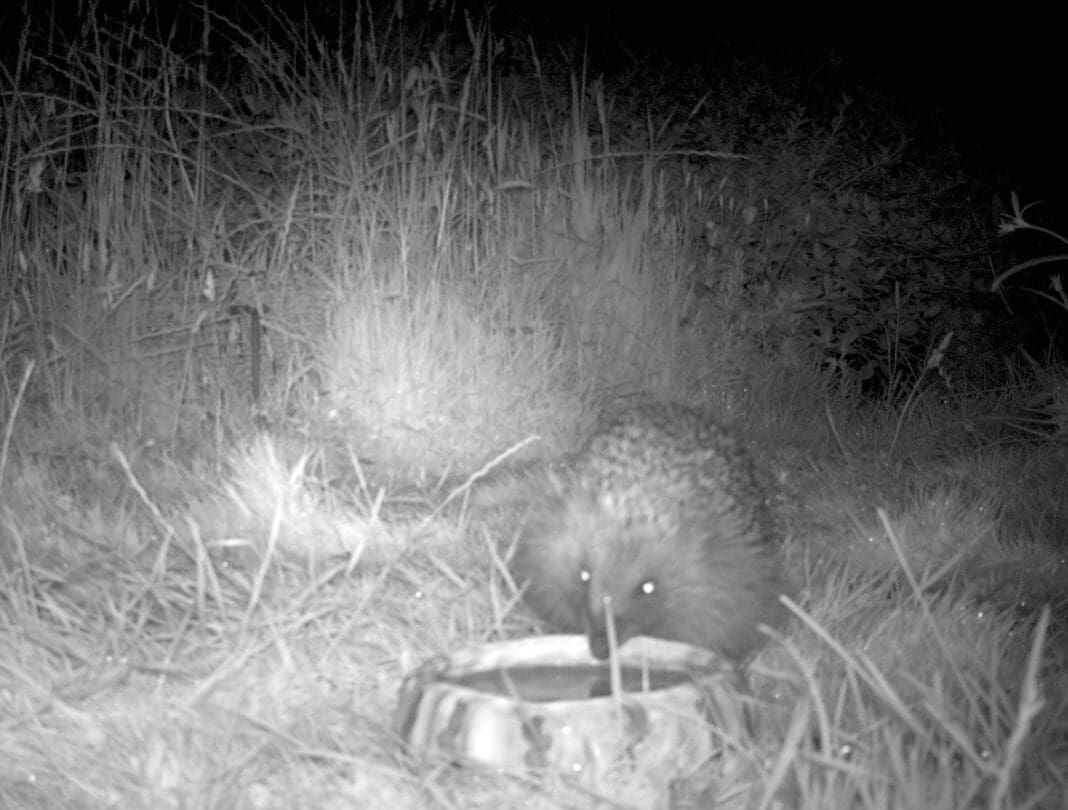

Continuing our theme of using equipment to see nature, have you ever considered getting a camera trap? Invaluable for wildlife research or just seeing what’s about in your garden, they are fitted with infrared motion sensors and can be left out overnight or for weeks at a time. The images or videos are recorded on SD cards so can be viewed on laptops or PCs. A camera trap can now cost less than £60, small beer compared to a trip to a garden centre or restaurant. You may be surprised to see what is visiting your garden at night, from mice to neighbours’ cats to foxes or even badgers. The Wildlife Trusts have a handy online guide “How to use a camera trap”.
A favourite find is hedgehogs. Having a hole in your fence allows them to travel from nearby gardens (see Hedgehog Street). If you know you have them passing through you can leave out some water (NEVER milk) and meaty cat food. One of our members caught the pictured hedgehog on her camera trap in June. Remember to look out for hedgehogs if you are strimming your grass or lighting a bonfire. They are good at eating slugs, so never use slug pellets or you will poison hedgehogs and anything else eating them.
If you see a hedgehog out in the day it is probably sick. Hedgehogs can hibernate from around November, but if they weigh under 600g they may not survive without help. Treatment advice and information from the British Hedgehog Preservation Society, rescue facilities at the Gower Bird Hospital and West Wales Hedgehog Rescue (Facebook).
In August we visited Tegwen Devichand’s land at Cynheidre. She has 54 acres of mostly unimproved pasture, woodland and a natural lake. David Poulter did some pond dipping for us and found a minnow and a leech as well as several crustaceans and mayfly larvae.
In the meadows there was an abundance of wild plants including Whorled Caraway and Meadowsweet. Crawling in the grass we saw many toadlets, grasshoppers and leafhoppers, and by the stream an impressive Artist’s Bracket fungus. Photos on our Facebook page.
Flowering June to October, Hogweed (Heracleum sphondylium) is a native plant which provides pollen and nectar for a wide range of invertebrates, including beetles, wasps and flies. It should not be confused with the non-native Giant Hogweed (H. mantegazzianum) which grows to 4 or 5 metres tall and whose sap can cause burns.
Here are some observations on wildlife garden structure from our new contributor “Herbie Green”–
One of the characteristics of a wild gardener is that of tolerance towards the many plants that have a tendency to move around. Many interesting plants may appear as seedlings, including the offspring of chosen plants. Some plants can move surprising distances via runners or underground rhizomes. Trees and shrubs tend to stay put, but the extent of their spread is not always anticipated. For aesthetic reasons, a strong garden structure is important. Within this, nature can more easily take care of the details, without any accusations that the garden has ceased to be. Techniques to strengthen structure can include the use of stepping stones, elimination of fussy edges, and a general emphasis on simplicity.
Seen many butterflies this year? Some of our members conduct a monthly survey at Pembrey Burrows Local Nature Reserve as part of their volunteering duties. In July they counted almost 500 in one afternoon! Over 200 were Gatekeepers, and an amazing 57 were Graylings; these butterflies sit on the ground with their wings angled towards the sun to minimize their shadow.
Carmarthenshire Nature Partnership’s Nature Notes for July-September are now available for download from the Carmarthenshire County Council website. Search for Carmarthenshire Nature Partnership and scroll down to the bottom. If you wish to subscribe to future Notes directly, email biodiversity@carmarthenshire.gov.uk.
Tip of the month: Don’t use artificial grass! Its manufacture creates pollution, it destroys the ecosystem underneath, supports no wildlife, contaminates the soil as it degrades, and cannot be recycled.
What’s happening this month:
Sunday 5th September is our next field trip when Ian Morgan will be leading his annual urban botanising walk, this time round the brownfield sites of Bynea. Meet 2.00 pm, Millennium Coastal Park car park on the west side of Yspitty Road (SS554984). All welcome.
22nd September is the autumn equinox and the first day of autumn, kicking off the month-long Seed Gathering Season. Find lots of information on growing trees from seed on the Tree Council website under Take Action/Take Part in an Event, and scroll down for Seed Gathering Season.
Advance notice: 2nd October is Fungus Day at the National Botanic Garden of Wales, see their website for details.
For information on Llanelli Naturalists email hainesveronica@hotmail.com; website www.llanellinaturalists.org.uk, Facebook page: www.facebook.com/llanellinaturalists.