











Now might be a good time to consider redesigning your garden. It’s always a good idea to plan features so you can see them from the house; especially important so you can observe birds and mammals without disturbing them.
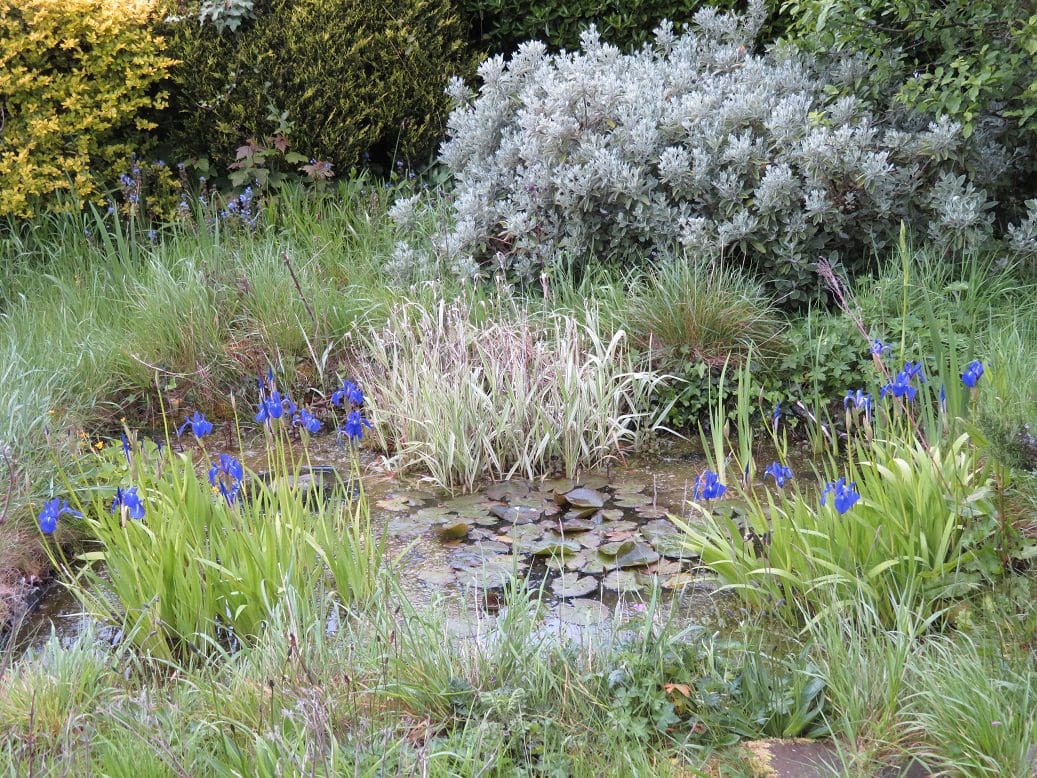
The best thing you can do for wildlife is to create a pond. Or if you have one, another pond; Herbie Green has three small ones and they’re all quite different, without deliberately planning it that way. A pond can become the focus of activity in a garden. The bigger the better, but even very small bodies of water can be very useful. A sunken bowl or bucket will fit into the smallest garden, but make sure anything falling in can get out again.
Even an upturned dustbin lid will encourage aquatic species, as well as being somewhere for the birds to bathe. Pond plants can be acquired from garden centres or you can just leave it to vegetate naturally. You will be surprised how quickly things arrive. Within a few weeks pond skaters will fly in from nearby water bodies, and in the spring damsel flies will be taking an interest. The Freshwater Habitats Trust have plenty of advice on pond creation.
“Hoverfly lagoons” can be a good addition. These are small containers or jars of water containing rotting vegetation. Many invertebrates, especially hoverflies, need stagnant water to lay their eggs, so you will need to add a few sticks or stems for the larvae to climb out when they are ready to become adult (plenty of advice online). It all helps to increase our diminishing populations of invertebrates, and will in turn encourage the birds which feed on them, as well as hedgehogs and bats, which help to control garden pests.
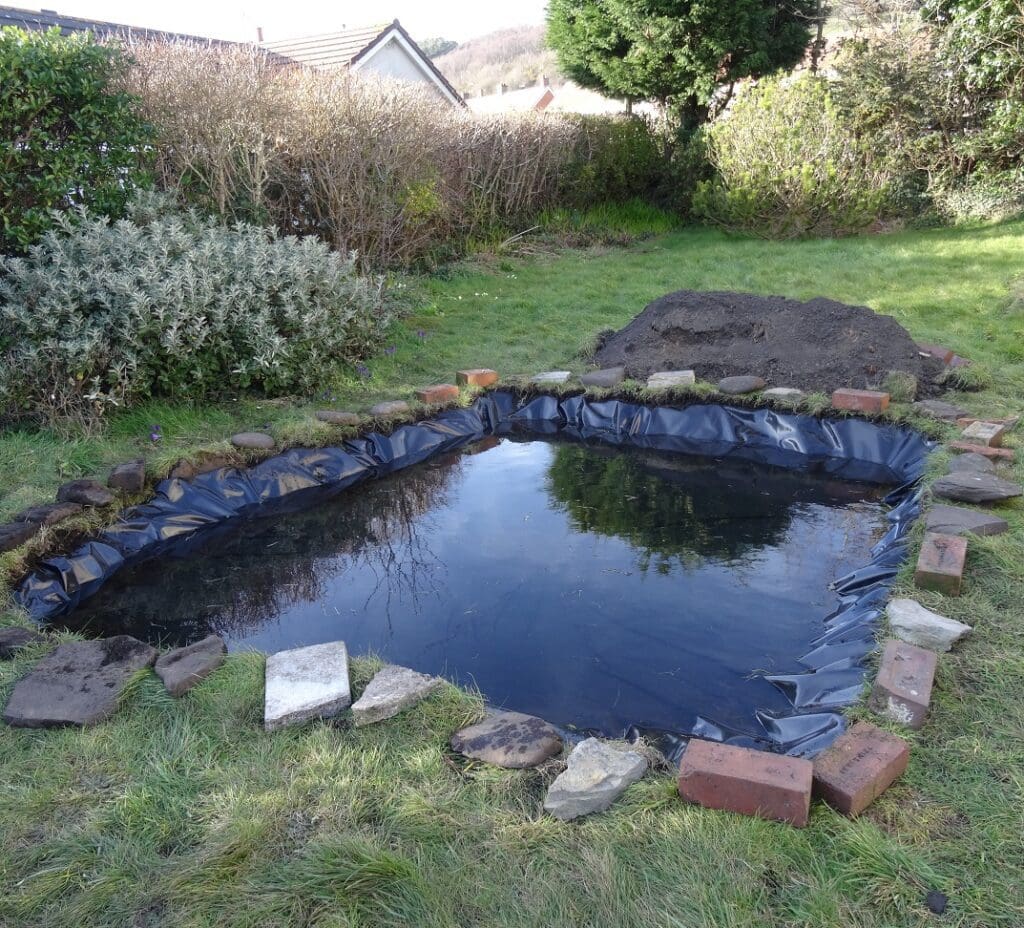
New garden pond … 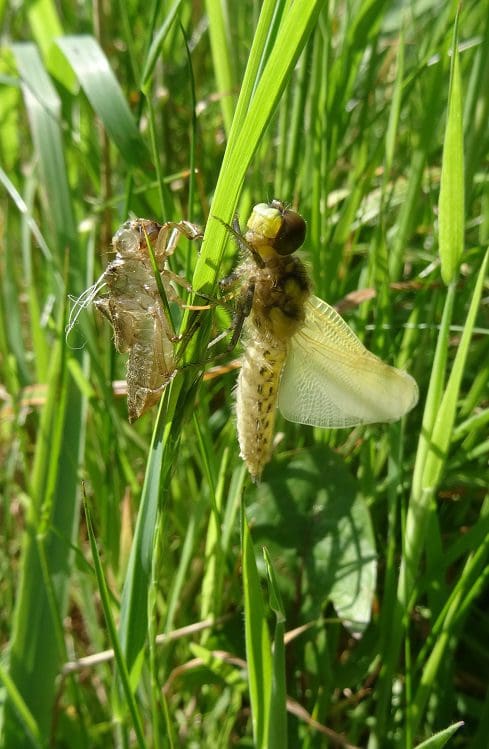
… and emerging dragonfly a year later.
Now there are no leaves on the trees it is easier to see the lichens. They grow very slowly and are sensitive to atmospheric pollutants. Lichen is not a single organism, but rather a community – they are made up of a fungus which provides the structure, and algae or cyanobacteria which do the photosynthesis. Lichens will grow on almost any surface, and can reproduce by producing spores, or by bits dropping off and growing elsewhere. They absorb water from the atmosphere but cannot retain it during dry spells, when they become metabolically inactive. As soon as there is moisture in the air the lichen absorbs water and the algae within can begin to photosynthesise.
Over 200 lichen species have so far been recorded at the National Botanic Garden of Wales. You can still catch their I Spy Lichen textile exhibition till the end of January, created by members of Stitching Botanical.
We had to resort to holding our Christmas Social on Zoom on 6th December, as a lot of members were not comfortable with meeting in person and sharing food, with the increasing spread of the coronavirus variants. We still had lots of pictures to show though, and couldn’t fit them all in, so there will be extra after our AGM in February. We had lots of photos of interesting wildlife from members’ gardens, and a selection taken in our Local Nature Reserves over the last couple of years. Our chairman topped it off with an in-depth look at dandelions, of which, surprisingly, there are at least 250 species.
Please note if you are already a member (and don’t have a standing order) our annual subscription is due for payment in January. Reminder: Single member £8.50, Concessions (over 60 or full-time student) £6.50, Family £10.00.
Tip of the month: Pondering your New Year’s resolutions? Instead of giving something up, why not start something new and help nature? Many organisations use volunteers to carry out maintenance or monitoring. Local examples are WWT Penclacwydd, the National Botanic Garden of Wales, Pembrey Country Park, Pembrey Conservation Trust, the Wildlife Trust and the National Trust at Dinefwr. There are also citizen science projects to get involved with, such as those organised by Earthwatch Europe. Volunteering in nature has been shown to improve mental wellbeing, so you would be doing yourself a favour as well as the environment.
What’s happening this month:
January 10th at 7.30pm Laura Bowen of the Sands of LIFE project will be giving us a talk on Zoom about restoring our mobile sand dunes. Link to be published nearer the date. Please note this is a change to our scheduled programme due to the uncertainty over Covid.
28th-30th is the Big Garden Birdwatch weekend. Count the birds you see during an hour in your garden or local park. Full instructions on the RSPB website. They will be broadcasting live on YouTube and Facebook throughout the weekend.
Thanks to Carmarthenshire Nature Partnership for content.
Membership enquiries: hainesveronica@hotmail.com. Website: www.llanellinaturalists.org.uk, Facebook: www.facebook.com/llanellinaturalists.