





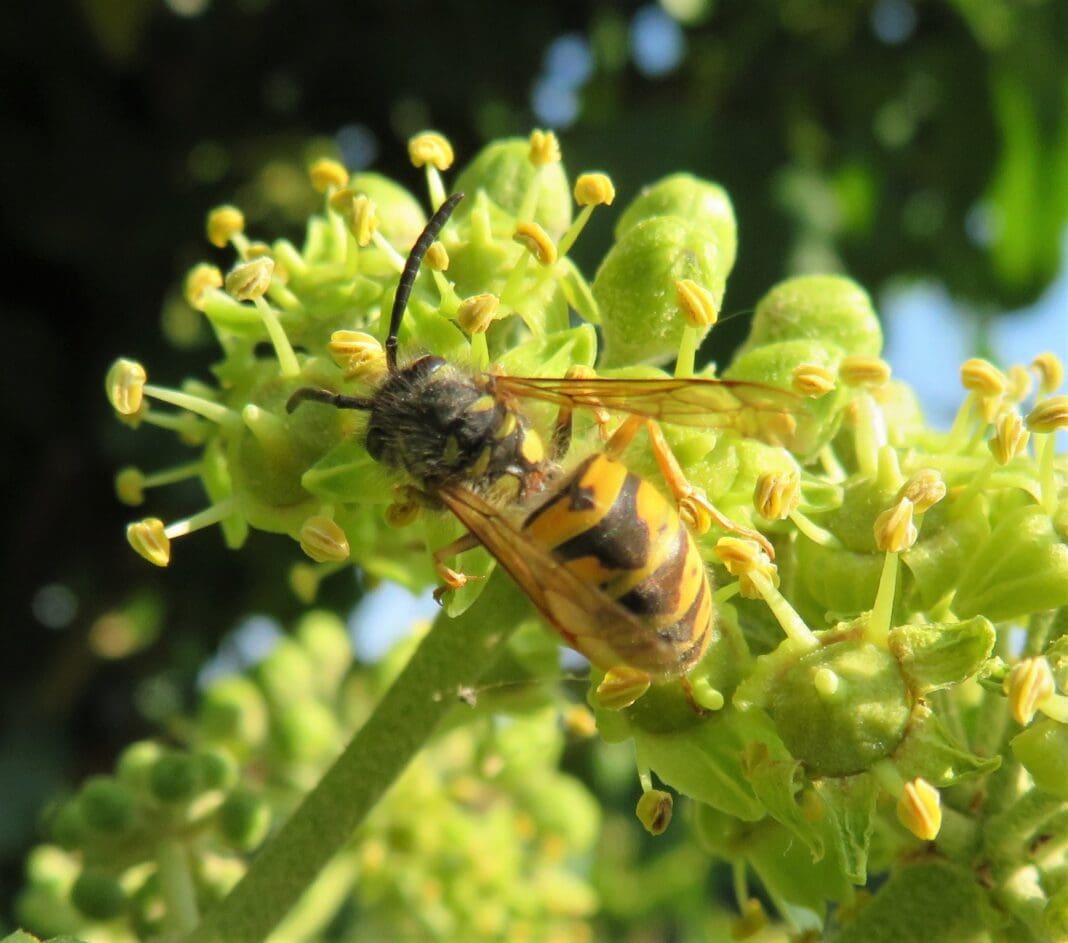


Wasps have an important role as pollinators and garden pest controllers. Most wasps capture, sting and paralyse their prey, which is then fed to their larvae. Most species are specific to a certain kind of prey. Like bees, most species are solitary. Some hunt spiders, some parasitise beetles, and some are cuckoos, laying their eggs in others’ nests. But the ones we are most familiar with are the black and yellow social wasps. Of the 9,000 UK wasp species only nine are social wasps, having large nests. The two we are most likely to come across are the Common Wasp (Vespula vulgaris) – known as “Jaspers” in the Midlands – and the German Wasp (Vespula germanica), the difference being that the German wasps have black dots on the back and three on the head.
There have been warnings in the media lately about an expected increase in social wasps this autumn. The dry weather means that more nests will survive. Adult workers (all female) emerge late in the summer and gather proteins to feed the larvae, and sugars to feed themselves, visiting flowers and pollinating them as they go. They take other insects such as aphids, flies and caterpillars into the nest and in return the larvae produce drops of sugary liquid for the workers. The size of the colony peaks in September, and as the larvae grow up and diminish in numbers so does the supply of sugary liquid. Thus the sugar-starved adults are seeking out sweet food and drinks. Once the single new queen leaves the nest in late autumn to overwinter, the rest of the colony dies.
See the Buglife website for more information, including their section on “Wonderful Wasps”.
Autumn is the time we associate with an increase of spiders in the house. There may be more around as a result of leaving doors and windows open in the summer, but they are more obvious now as the males of many species reach adulthood, leave their webs and wander about looking for females.
Some people lump spiders in with insects, but they are in fact Arachnids, having 8 legs (insects have six) and no antennae, and belong to the same class as scorpions, ticks and mites.
They shed their exoskeletons several times when growing, so sometimes when you think you’ve found a dead spider it is in fact a shed skin, which is usually translucent. If you don’t want them keeping down the population of flies in your house you can put them gently outside.
We had an informative walk round Pembrey Burrows last month with Lauren Bowen of the Sands of LIFE project. She explained the importance of mobile sand dune systems (a diminished habitat) and the ecosystems they support. She showed us scrapes and slacks made to increase the amount of bare sand, and a large notch cut in the foredunes to encourage loose sand to blow through. Ongoing monitoring measures groundwater and the amount of sand “rain” produced by the notches.
Tip of the month: Now’s the time to cut your grass. Collecting it up into a pile will provide a home for slow worms as well as returning the carbon to the soil. Try to leave some areas long for the wildlife to overwinter. If your grass has become matted you can scarify it with a rake to allow seeds to reach the ground to germinate.
What’s happening this month:
2nd September: Our field trip to Parc Howard to study its planted trees and shrubs, led by Ian Morgan. Meet 2.00pm by the mansion.
9th, 10th or 11th September: Carmarthenshire Bird Club’s second Tern Watch at Pembrey Old Harbour before the evening high tide. Details on website.
10th September: High Tide Watch at Llanelli Wetlands starting 5.30pm. Booking essential. £15 inc. refreshments.
16th-25th September: Marine Conservation Society’s Great British Beach Clean. Look out for, or create, local events.
23rd September-22nd October is Seed Gathering Season. Starting on the autumn equinox, this campaign promoted by the Tree Council aims to inspire everyone to gather seeds, fruits and nuts and grow the trees of the future. Plenty of info on their website.
25th September is National Get Outside Day, promoted by Ordnance Survey. Ideas and guides on their website.
Coming up next month:
1st October: Fungus Day at the National Botanic Garden of Wales.
(we have our own Fungus Foray at Pembrey Country Park on 9th)
3rd October: our first indoor meeting of the winter at EJ’s Café Bar & Restaurant; Rob Parry is updating us on the work of the Initiative for Nature Conservation Cymru.
3rd-7th October: Wales Biodiversity Partnership Conference online. Theme: The Global Biodiversity Emergency: actions and solutions from Wales. Registration on the WBP website nearer the time.Further info: hainesveronica@hotmail.com. Website: www.llanellinaturalists.org.uk, Facebook: www.facebook.com/llanellinaturalists.