





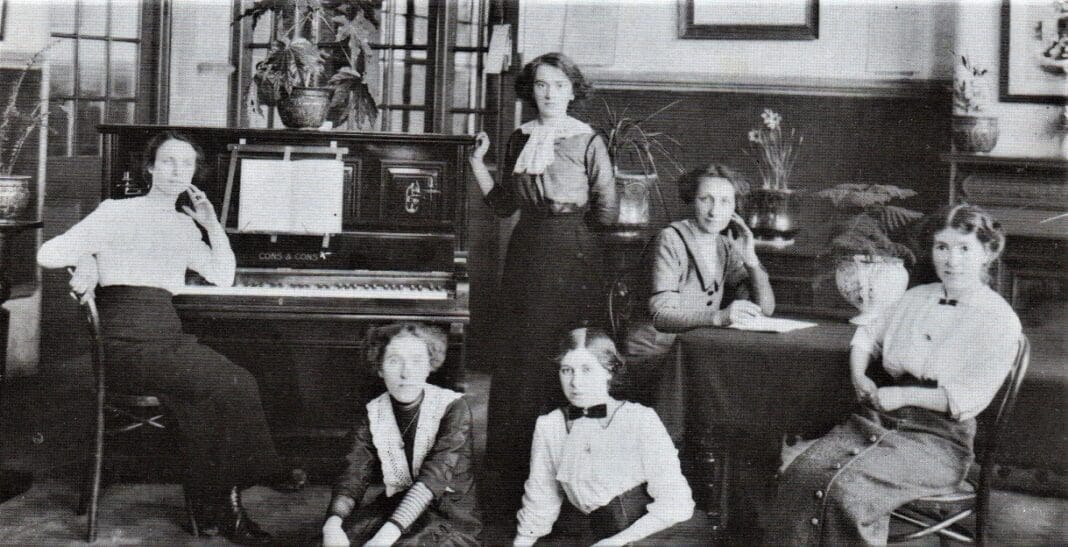

“The hand that rocks the cradle rules the world”, so says the old adage. But it gives a somewhat false impression of the status of women – their sphere was very much the hearth and home. When in 1870 all children were to be given the opportunity of a school education the girls’ curriculum was very much directed towards subjects that would help them be “good wives” and home managers.
In the 19th century there were not many jobs open to women outside the home, but teaching was to become one of them. There had always been governesses for the rich, ragged schools and dame schools for the poor, as well as the Sunday Schools to educate of what were regarded as the ‘lower orders’. Yet as the school movement grew it became apparent that teachers with some kind of training were needed, and the pupil teacher, following the demise of the monitorial system, was seen as a way to address this.
In the schools in the Llanelli area boys and girls became pupil-teachers usually around the age of 13 to 15 years, but many boys later left the training to pursue more lucrative jobs. Although pay was not high, women were attracted to teaching because it promised reasonable pay and better prospects than factory work or domestic service. It also provided independence for unmarried women, even though they were paid less than men. For example, a male pupil-teacher was on average paid £13.9d per year while a female was paid £12.15s.
Often the girls would come from a large working class family, perhaps the only older girl, and she would have to do her share of household task both for the good of the family and also for her own good. For if she failed to get a Queen’s Scholarship, or if she did marry she would not be regarded as a good housewife. not having had experience of domestic work.
Marriage was mostly not an option for women teachers since when they married they were expected to resign. They were sometimes ridiculed for their status as a “spinster” and regarded as unsuitable to teach older boys. Women were also held to a high moral code, expected to conform to and to demonstrate the values and attitudes of the Christian faith, often to a greater extent than their male colleagues. Also, a certain dress code was expected and some education committees forbade the wearing of “flowers, ornaments or finery”, since they were afraid it might distract their pupils. A sober style of dress was required.
Victorian society was dominated by social class, and this proved to be the case for teachers as well. One of the promotors of higher education for women stated in 1866 that her school admitted only the daughters of independent or professional men. However, at the other end of the spectrum there were those who had a great desire to be teachers but were unable to pursue this because the family could not afford to release them from domestic chores or even pay for their transport to a college. To help out at home often took precedence over a girl’s wish for a teaching career.
It was sometimes thought that working class parents would not want their daughters to be taught by middle class teachers who would give them ideas above their station, so it was not seen as important for women to train to a higher level and for them to go to training college or university They would continue in the classroom learning “on the job”, being paid less and an attractive employment opportunity for Education Boards.The scale of payments for women teachers was two-thirds of that of men, which diminished their status even though gradually women proved themselves academically to be at least the equal of men in education. However, the new educated professional groups of women provided a feminist voice and this included female teachers and headteachers, such as headteacher Catherine Davies of Llanelli. In 1904 the Equal Pay League was formed to fight for women’s financial equality and this became the feminist National Union of Women Teachers. The union also took on the marriage bar, maternity rights and family allowances, yet it was not until 1961 that it achieved equal pay. Remarkably, Trinity College Carmarthen opened in 1848 to train young men for teaching but it was not until 1957 that female students were admitted. For women professional equality has been a hard struggle.