








Spring is a good time to sow wildflower seeds in your garden or window box. It is important to know the origin of seeds as many that are available commercially have traces of synthetic insecticides.
The National Botanic Garden of Wales Saving Pollinators Assurance Scheme has a list of growers who do not use such chemicals, or peat-based compost. Look for the “Saving Pollinators” logo. Beware also of wildflower mixes containing non-native or non-local species as these may hybridise and affect the gene-pool of our local flora.
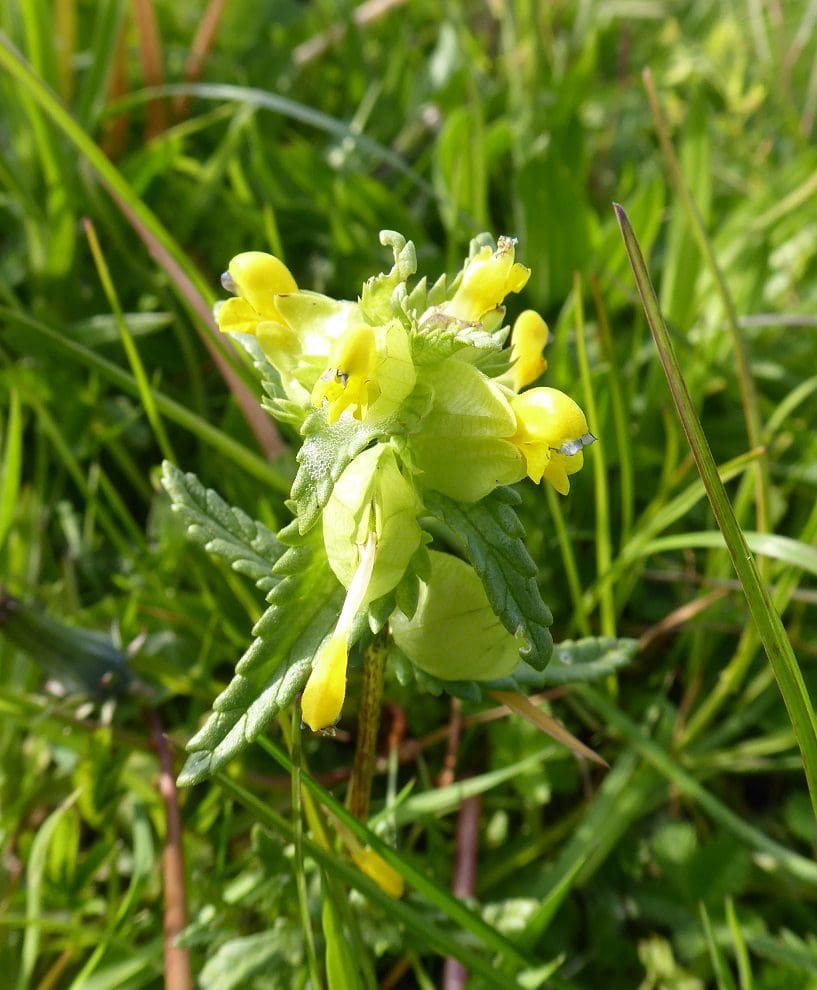
Yellow Rattle (Rhinanthus minor) is a good plant to establish as it is partially parasitic on grasses and will reduce their vigour, allowing more flowers to come through (pictured). When dried and brown the seed pods rattle in the wind.
When considering planting for the spring, bear in mind non-native annuals do little to support the huge numbers of invertebrates that feed on native meadow flowers.
Establishing mixes of perennial native flowers, which don’t require sowing each year, will require minimal annual management and bring greater benefits to a wider range of wildlife.
This is the time to look out for frog and toad spawn. Frog spawn is laid in clumps which can be spotted on the surface of ponds and puddles, whereas toad spawn is laid in strings, usually in deeper water around plant stems and is less easy to spot.
The Common Frog (Rana temporaria) prefers shallow water to lay its eggs, often in temporary puddles, hence its name. Adult frogs have smooth skin, longer hind legs for hopping, and a dark “mask” marking behind the eye. However the Common Toad (Bufo bufo) has rough or warty skin and crawls rather than hops. Female toads are larger than the males. Both species have variable colouration. Frog tadpoles become bronze-coloured as they grow, whereas toad tadpoles remain dark. Some tadpoles may not transform until later in the year or even the following winter. They can sometimes develop more rapidly if the water is drying up.
If you find any spawn, the Freshwater Habitats Trust would like to know about it for their spawn survey.
If you’d like to set up or join a Toad Patrol, look up Froglife’s Toads on Roads project. There’s currently an active patrol in Burry Port.
Our Zoom AGM took place on 7h February. After the usual reports were received, our Chairman Richard Pryce discussed plans for the year’s programme as well as that for 2023, which will be the 50th anniversary of the formation of Llanelli Naturalists. Richard showed photographs from the five field meetings held during 2021.
Of particular interest was the Wild Service Tree (Sorbus Torminalis), an uncommonly found ancient-woodland indicator seen at a member’s farm. It bears white blossoms in late spring and the leaves are similar to maple but turn crimson to copper in autumn. Suckers spread out from the tree as it ages, up to 100m away. The clusters of small brown fruit are known as “chequers” and used to be made into alcohol, hence the name of “Chequers Inns”, and the Prime Minister’s country residence, where they grow in the grounds.
Tip of the month: Leave nettles if you can as they are the food plant for the caterpillars of Red Admiral, Peacock, Small Tortoiseshell and Comma butterflies, and some moths. You may need to leave a fairly large patch to be effective. Stinging Nettles (Urtica dioica) have several medicinal uses. The young tips are recommended for flavour if you want to cook them or make tea, and are best picked from now to early June.
What’s happening this month:
The BTO’s Nest Record Scheme runs from March to May: you can get involved by following the progress of one or more nests and sending in your findings. Search for “Nest Record Scheme”.
3rd March is World Wildlife Day. This year it will be celebrated online under the theme “Recovering key species for ecosystem restoration”. Information and links to the events will be posted on their website: www.wildlifeday.org.
5th March: free “Nature Engagement Event” at Pembrey Country Park, “Early Spring”, meeting 2.00pm at the Log Cabin. Book first: 01554 742435
7th March: the last of this winter’s indoor meetings is an introductory level illustrated talk on Carmarthenshire’s Butterflies by Dr. Deborah Sazer. This will be held on Zoom – please email for the link. Our programme of field trips will begin next month.
Until 27th March: Biophilic Wales exhibition at the National Botanic Garden of Wales, showcasing work accomplished across three projects to increase the wellbeing of people, biodiversity and the environment.
27th March: CLOCKS FORWARD at 1.00am.
28th March-3rd April is Wales Outdoor Learning Week: ideas for parents and teachers.
More info: hainesveronica@hotmail.com. Website: www.llanellinaturalists.org.uk, Facebook: www.facebook.com/llanellinaturalists.