








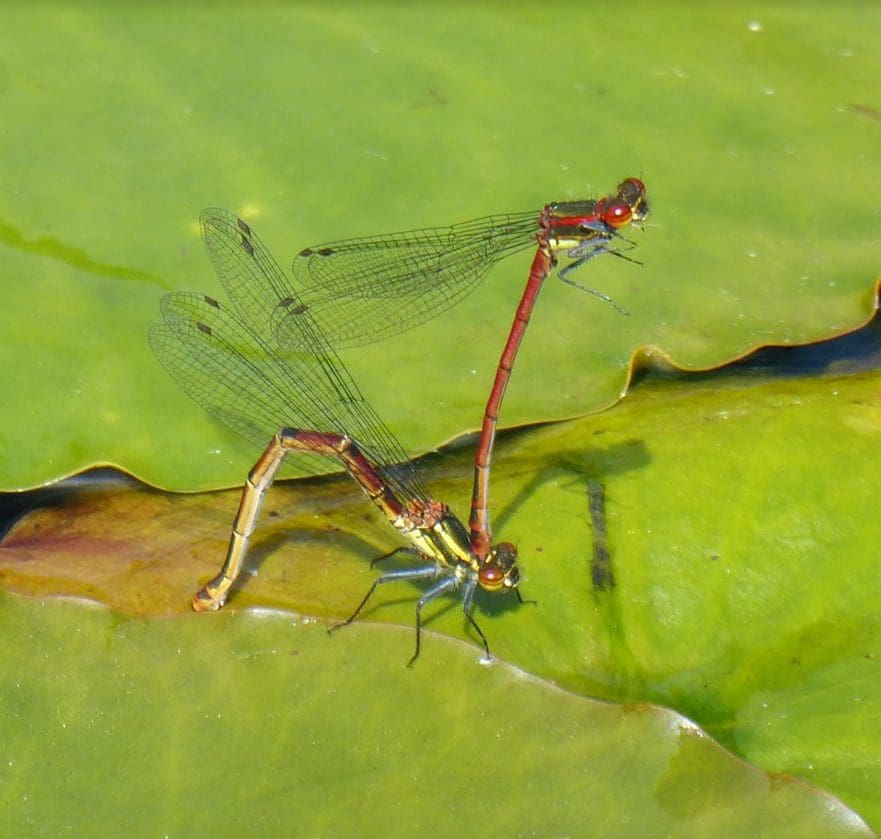


Damselflies will be appearing this month on our lakes and ponds. The first to emerge is the Large Red Damselfly (Pyrrhosoma nymphula), followed by the blues: the Common, Blue-tailed and Azure damselflies which are all commonly seen, the females being less colourful than the males. However some species, particularly those found in marshland, are struggling. Marshy and boggy habitats have seriously diminished due to land drainage for agriculture or building, pollution and peat extraction.
The number of ponds as a whole has also greatly diminished as old ponds have been filled in, drained or built on. This is affecting the wider population of damselflies and dragonflies, so creating a new pond in your garden is something you can do to help. Even a fairly small pond will attract these species, especially if you live near an existing habitat. The eggs are laid under water and these develop into nymphs, which can live at the bottom of a pond for between a few weeks and several years. They shed their skins as they grow, and for the last moult they climb out onto emergent vegetation, leaving their old body casing, or exuvia, behind. Newly emerged damselflies have no colour, and as they flutter away their wings glitter in the sunlight, which always makes me think of fairies! The adults will only live for a few weeks. Further information from the British Dragonfly Society.
Under the Wildlife and Countryside Act 1981 it is an offence to cause harm to any wild bird, its eggs, or its nest while in use or being built, so be careful around hedges and trees between March and August. Hedge and tree trimming is best left till the autumn unless you can be sure there are no nesting birds present.
Over a dozen British bird species nest on the ground, such as Skylarks, pipits and Ringed Plovers, so please KEEP DOGS ON LEADS during the nesting season when you are out on rough grassland or in the dunes.
A pretty native flower out in woodlands and gardens in May and June is the Columbine (Aquilegia vulgaris), so called from the Latin for dove as the flower looks like a cluster of doves. Also the genus name refers to the Latin for eagle (aquila) because of the resemblance to an eagle’s claw. Another common name is Granny’s Bonnet. It is the food plant for the caterpillars of several moth species, although its seeds and roots are highly poisonous.
In medieval times, Columbine was apparently thought to be eaten by lions. Rubbing the flower on your hands thus gave you a lion’s courage!
Tip of the month: It’s NO MOW MAY! See what wild flowers grow in your grass. Watch what insects are using them, or just crawling about in the long grass. You could even go further and resist cutting till late summer. By allowing nature to take over you will see which plants will do best in your particular situation.
What’s happening this month:
1st-7th May: Hedgehog Awareness Week, celebrating 40 years of the British Hedgehog Preservation Society.
12th May: the National Botanic Garden of Wales is offering a Wildlife Gardening Course, see their website for details and how to book.
14th May: 10-11.30 early summer guided walk at Pembrey Burrows & Saltings Nature Reserve, organised by Carmarthenshire’s Outdoor Recreation Service. Meet at Ski Centre, Pembrey Country Park. Pre-book: 01554 742435.
16th-22nd May: Invasive Species Week. See nonnativespecies.org/what-can-i-do/invasive-species-week for info and resources.
19th-21st May includes Moth Night (depending on weather); to take part, see mothnight.info.
22nd May: our second field meeting, at Monk’s Treasure, Capel Teilo Road, Kidwelly, SA17 4RN (Morfa Bach on the O.S. map) SN437069, by kind invitation of, and led by Julie Sanders: a walk in the ravine woodland and meadows: how wildlife and tranquility can help restore human wellbeing. Meet at the centre, 1:00pm. Non-members welcome.
22nd May: Biodiversity Day, this year’s slogan is “Building a shared future for all life”. See cbd.int/biodiversity-day for how you can contribute.
28th May: early summer guided walk at Mynydd Mawr Woodland Park. Meet in main car park, 10.30-12.00. Book with Outdoor Recreation: 01554 742435.
The last week of May is the time for Plantlife’s Every Flower Counts survey – plenty of info and links on their website.
Looking ahead: 1st-7th June is Volunteers’ Week – what could you do? Look it up on volunteersweek.org.
Thanks to Carmarthenshire Biodiversity Partnership for contributions to content.
If there’s any subject you’d like to see covered in this column, please get in touch.Hopefully our 2022 Newsletter should be printed this month and will be distributed free to members. At around 40 pages it is packed with interesting items on local wildlife, as well as the society’s activities. Membership starts at £6.50pa. Enquiries: hainesveronica@hotmail.com, www.llanellinaturalists.org.uk, www.facebook.com/llanellinaturalists.