





There’s plenty of wildlife to see at this time of year. Young birds are leaving the nest, flowers are blooming, and a host of pollinators and other invertebrates are enjoying the bounty. So much of this can be missed if we only use the naked eye. A pair of binoculars can bring extra wonders so much closer to you. These need not cost the earth; even a cheap pair will give you a window into a larger world, though a better pair will show you a lot more. You can sometimes be lucky in charity or “cash generator” shops, or borrow from a friend or relative. With a bit of practice you can identify birds singing in the trees or feeding out on the estuary. Don’t forget to look up for birds of prey: Red Kites, Buzzards and Kestrels are not uncommon in this area. With “close-focussing” binoculars you can also see the details on butterflies and bees that are only a few feet away.
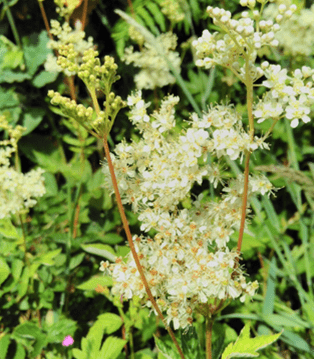
Look out for Meadowsweet (Filipendula ulmaria) this month. It is a tall perennial herb of the rose family which provides a frothy display of tiny cream flowers in damp areas of the county. Queen Elizabeth I used to order meadowsweet from Carmarthenshire as a “strewing” herb for Hampton Court. The herbs were laid on the floor, so that pleasant odours would be released when people walked on them. She thought our Meadowsweet smelt better than anyone else’s!
The council are now undertaking their annual programme of cutting roadside verges, though in many cases only a metre wide swathe will be cut for reasons of safety. So enjoy the wild flowers in our verges and hedges while they are there. Hedge banks often have a greater variety and abundance of flowers because the cuttings fall down to the ground. This reduces the fertility of the soil in the bank and weakens the grass. Verges can be affected by salt, fumes and pollution, but It has recently been found that pollinators tend to avoid areas where pollution is greatest.
In a project funded by the Welsh Government, Carmarthenshire Nature Partnership together with the West Wales Biodiversity Information Centre has recently produced “Wildlife in your Ward” profiles for the electoral wards in Carmarthenshire. Along with photos, these describe the wildlife to be found in each area, with links to a wealth of information. Now on the council website: Wildlife in your Ward (gov.wales).
The April-June Nature Notes are also now available on the CCC website. Search for Carmarthenshire Nature Partnership and scroll down to the bottom to download them. This quarter they are highlighting Carmarthenshire habitats: gardens, woodland, wetlands, grasslands, peatlands and coastal.
What’s happening this month:
3rd July: National Meadows Day, kicking off another week of the Big Meadow Search – see Carmarthenshire Meadows Group blog.
N.B. our recent search in the wild corner of Pwll Park revealed over 60 different species of plants, including several Bee Orchids!
4th July: Our next field trip is to Waunygweil Fach farm near Four Roads, led by Andrew Stevens. Meet at the farm (SN449086) at 2.00pm: take the Mynydd-y-Garreg road from Kidwelly to Four Roads, turn right at the crossroads and follow the road for about 1km when the farm will appear in front of you.
3-11 July: Swift Awareness Week. The sound of swifts is the sound of summer, but the eaves of modern houses do not allow for their nests. The Swift Conservation website has information on how you can help this declining species.
8-10 July: National Moth Night, this year targeting reedbed and wetland moths. Details on: mothnight.info.
16 July – 8 August is this year’s Big Butterfly Count, organised by Butterfly Conservation. For information on counting the butterflies in your garden, look up Big Butterfly Count.
17-25 July: Dragonfly Week, organised by the British Dragonfly Society. For events, search for Dragonfly Week.
24th July-8th August: National Marine Week – look it up to see how you can get involved.
25th July is International Bog Day. Look out for events and info on bogday.org. Carmarthenshire has its own bog project at Pwyllau Cochion, near Horeb, and restoration work has also been undertaken at Llyn Llech Owain peat bog.
Tip of the Month: Don’t use peat-based compost! This depletes a scarce and dwindling habitat which is an important carbon sink. Peat bogs also act as sponges, helping reduce the risk of flooding.
My thanks this month to David Poulter and the Carmarthenshire Nature Partnership for their input.
As I write, our extra long Llanelli Naturalists 2021 Newsletter is being printed, so hopefully it will have been distributed to members by now. For info and membership enquiries email hainesveronica@hotmail.com or see our website (currently being revamped) or Facebook page.